Displaying Empire
Britain's visual encounter in India
The East India Company began as a mercantile corporation, chartered by Queen Elizabeth in 1600, to expand mercantile trade in commodities such as spices, cotton, tea, and silk. By the eighteenth century, the Company became a militarized governing presence driven by resource extraction. The Company’s stronghold in India attracted professional and amateur British artists, some of whom were part of its military and administrative network. Others, seeking to further their careers, traveled in India extensively, often relying on the support of local experts to record their impressions.

Indian Spices for English Tables; or, A Rare Relish of Fun from the Far East
A clumsy dismount from a local dinghy. Perilous camel rides. “Obedient” local servants. These are just some of the caricatures presented in Indian Spices for English Tables’ 120 lithographic sketches that fill the twenty-seven pages which chronicle the British East India Company officer George F. Atkinson's travels through India.
Black-and-white satirical sketches and captions, arranged like a modern graphic novel, were made during Atkinson's tenure from 1840-59 in the Bengal Engineers regiment of the Company's military. The book’s sense of authenticity, conveyed through Atkinson’s insistence of his first-hand accounts, and its accessible illustrations are a testament to the British interest and demand for narratives about the lives of its expatriates in India.
An Indian woman burning herself on the death of her husband
An Indian woman is powerfully poised over her deceased husband’s burning pyre, with a fist raised. Early European accounts of India recorded the ritual sati as an honorable death for a widow, sparing her from societal disapproval and the loss of certain social liberties.
Published in Hamilton Moore’s 1785 New & Complete Collection of Voyages & Travels, this was one of many prints circulated within British society that played upon the fear and fascination of unfamiliar and diverse cultural practices and lifestyles. This arcane practice was exoticized as a spectacle for the British gaze and would continue to be portrayed by artists and travelers.
A Suttee: Preparing for the Immolation of a Hindoo Widow
Sati (or suttee as it was anglicized by British colonizers), a remote ritual sacrifice of a widow on the funeral pyre of her husband, became a touchpoint for colonial reform. Here, a bare-breasted woman draped in a white garment prepares for sati amongst a crowd of Hindu worshippers at the ghats of river Vishwamitri against a backdrop of temples and shrines in the city of Baroda (present-day Vadodara). Although both British and Indian communities had pushed for sati’s abolition, colonial lawmakers often cited the ritual's brutal nature as justification for reform of religious and cultural practices in India. The British government officially outlawed sati in 1829.
The print appears on page 7 of Fisher’s Drawing Room Scrap Book (1836), consisting of 36 engravings accompanied by descriptions. Such printed editions were designed for sale to consumers in Britain and Europe, as table-top books that could be perused for entertainment and leisure.
No. 25 View of Stone Bridge from Moosah Bagh End of the City. No. 26 View of the Great Iman Barra and the Roome Durwaza. No. 27 Moosah Bagh in 'General views & special points of interest of the city of Lucknow: from drawings made on the spot'
This lithograph features architectural monuments of the city of Lucknow, following its military takeover after the Indian Rebellion of 1857, which was characterized in British narratives as a Sepoy Mutiny. Centered in the print is the gleaming Gompti River that reflects the trees and prominent buildings along its shore, welcoming the viewer into the city.
The print is a fictionalized composition that juxtaposes Lucknow's local architecture with the unsettling presence of British military officials and canons. Such depictions catered to the widespread interest in the "Mutiny" amongst British families and the public.
The Shaking Minarets at Ahmedabad
This print is the earliest known published documentation of the Sidi Bashir Mosque in Ahmedabad, western India. The view is centered on the twin prayer towers of the mosque, known for shaking in tandem when ascended, such as during a call for prayer.
The British military officer Robert Grindlay first recorded this mosque while deployed with the Bombay Army. He would later start the influential Grindlays Bank, with various branches across British India. Grindlay’s detailed delineation of the mosque’s architectural and ornamental elements informed future survey and preservation activities.
British India
The Company’s extensive cartographic surveys of India were initially produced through labor intensive means, requiring numerous assistants and local aides for measuring and moving instruments across a diverse terrain. With technical advancements, maps offered greater precision in delineating natural features, land- and sea-based trade routes, and infrastructure.
This hand-colored map reproduces a plate for an Atlas featuring the “Geographical, Political, Commercial & Statistical” history of the world, edited by statistician Robert Montogomery Martin, who compiled administrative data on British colonies. Vignettes of the ethnic population of Baluchis, a Mughal royal procession, the city of Lahore, and the Qutb Minar at Delhi, situate its wide-ranging geographic and cultural parameters. Colored boundaries indicate three major “Presidencies,” administrative divisions, military cantonments, and civil stations. Rapkin used a dark hatching for proposed railways that, within a decade, would become reality, connecting major cities of the subcontinent.
Tombs of the kings of Golconda
This European travelogue print, depicting the necropolis of the Qutb Shahi dynasty, was made for British audiences to learn about faraway sites in India, offering them as popular tourist destinations. It depicts tombs of the sultans (rulers), who ruled the Deccan province of Golconda from 1518 to 1687.
The nine tombs follow the dynastic style, a fusion of Persian, Pathan, and Hindu forms. The double-height structures are topped with tall onion domes, decorated with arcades of pointed arches. The buildings’ facades are intricately ornamented with lime stucco, plaster, and pillars. In the foreground, local merchants with camels and military personnel are portrayed as visitors to this site watched over by British officers.
The Great Triad in the Cave Temple of Elephanta near Bombay
This hand-colored print depicts the Hindu god Shiva (Sadashiva) carved into the rock-cut temples popularly known as Elephanta Caves. Created from a distanced vantage, the view shows a torch-bearing figure who illuminates sculpted guardian figures flanking the central deity, with three visible adjoined heads: fierce, pensive, and gentle. To one side are three turbaned men dressed in white tunics and brightly colored shawls. Large columns frame the entrance, while a mound of earth recedes into the shadows.
The view evokes the intimacy of a sacred interior while maintaining the detachment of an observing foreigner’s gaze. Drawn on site by Westall in 1803, engraved by T. Edge and published by Grindlay in London, the image emphasizes the iterative process through which sites in India reached British audiences.
A Hindoo Place of Worship
A tall column of a pillar-shrine, decorated with a canopy, rises up from a mound surrounded by trees. It is venerated by three figures: one standing, one bowing, and one seated.
This print is based on a view created by the British landscape painter Thomas Daniell during his travels to India between 1786 and 1793. It was featured in the artist’s Oriental Scenery series that showcased India’s cities and landscapes to British audiences.
Like Daniell’s other views, the image utilizes a picturesque compositional frame. Techniques such as delineating light and shade, dramatic clouds, and thick vegetation, create a romanticized impression of a site harmonious with nature but also consumed by it.
Dancing Snake and Musicians
A snake charmer plays his bīn, a traditional Indian wind instrument, while a hooded snake rises from the ground. This exoticized Indian bazaar scene is based on a drawing purportedly made on-site by Baron de Montalembert, a French officer serving in the British Army.
The engraving was published in a volume entitled Oriental Memoirs, by James Forbes, a British East India Company official who was also Montalembert's father-in-law. The combination of techniques, especially the choice of soft-ground etching in the shadings lends the print a sense of immediacy. The print’s self-attribution as an authentic representation drawn from an eyewitness account reflects how travelogue illustrations orientalized India’s people and lifestyles, while also serving as informal catalogs of dress, customs, and occupations.
Ceremony of weighing the Great Mogul
The Mughal emperor stands on a large scale, surrounded by royal attendants and curious onlookers. This historically inaccurate depiction is a distorted version of a charitable weighing ceremony marking the emperor’s birthday, where equivalent donations of food, clothing, and commodities were distributed to the poor. Derived from a circulating Mughal manuscript folio, the view shows the emperor standing instead of sitting, within a makeshift tent.
The print is part of John Hamilton Moore’s A New and Complete Collection of Voyages and Travels (1785). By refashioning a Mughal weighing ceremony into a circus-like spectacle the print reflects a European taste for exotic scenes of the distant “Orient.”
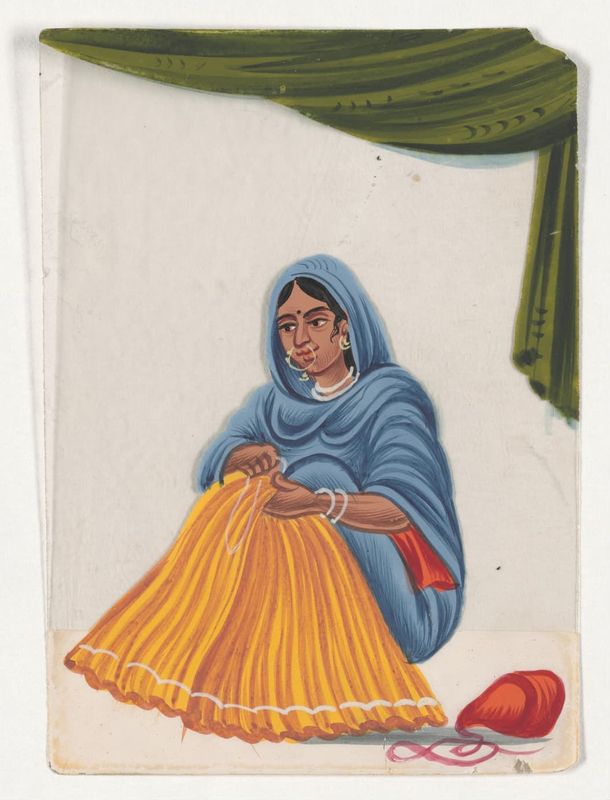
Miniatures on mica, seated woman sewing
An unidentified Indian artist's portrayal of a seated woman working on the fabric of a ghagra (folk-style pleated skirt) propped over her raised leg served as a visual identifier of her trade as a seamstress or embroiderer. Painted with vivid natural pigments and fine shading on a laminated silicate mica sheet, this miniature was typically sold within souvenir sets of Indian subjects.
Depicting occupational types rather than individuals, these taxonomic images compress an array of standarized faces and poses into pocket-sized catalogs. Though such pictures catered to European exoticizing sensibilities, their use of colors derived from natural Indian pigments also maintained a sense of ethnic connectedness to India’s laboring populations amid commercialization of their land, resources, and ways of life.
These works from the Donald Adams and Lawrence K. Stewart Collection of Prints (Charles Deering McCormick Library of Special Collections and University Archives) index a long period of British occupation in South Asia. British works on India circulated within markets through private and public sales. They were also licensed to other artists and engravers and incorporated into prints and publications. The works in this digital gallery, with the exception of the mica painting (last image), were all printed in England, intended for public consumption. They cover a vast array of geographic and sociohistorical representations, indicative of a larger British market for images of India’s life and landscape.
The subject matter of these prints lies at the intersection of cultural exoticism and local practice. Although they share an audience, the contexts of the artist-makers vary. Several works were created with the help of local Indian artists, commissioned by British authors, who drew on their artistic skills and methods to produce representations of diverse cultures and places. Other works were created solely by British officers/ artists who took on journalistic and satirical representations of their travels.
Map of British India
The Company’s extensive cartographic surveys of India were initially produced through labor intensive means, requiring numerous assistants and local aides for measuring and moving instruments across a diverse terrain. With technical advancements, maps offered greater precision in delineating natural features, land- and sea-based trade routes, and infrastructure.
This hand-colored map reproduces a plate for an Atlas featuring the “Geographical, Political, Commercial & Statistical” history of the world, edited by statistician Robert Montogomery Martin, who compiled administrative data on British colonies. Vignettes of the ethnic population of Baluchis, a Mughal royal procession, the city of Lahore, and the Qutb Minar at Delhi, situate its wide-ranging geographic and cultural parameters. Colored boundaries indicate three major “Presidencies,” administrative divisions, military cantonments, and civil stations. Rapkin used a dark hatching for proposed railways that, within a decade, would become reality, connecting major cities of the subcontinent.
About Art History 395, and the curating of this exhibit
The term “Company Painting” has come to stand in for works produced by artists associated with the East India Company over the course of the consolidation of the British Empire in India from the eighteenth to the twentieth centuries. Works in this broad category range from depictions of customs and occupations, natural history subjects, and topographical paintings embodying the complex visual processes that shaped Britain’s reimagination of India as an extension of its empire.
This Winter Quarter 2026 museum seminar focused on a cache of Company-associated paintings, prints, and illustrated books in Northwestern’s Charles Deering McCormick Library of Special Collections and University Archives. Students conducted individual and collaborative research through the direct study of selected works and their colonial and art historical contexts; they also gained exposure to techniques of painting and print making and conservation science methods through the participation of the Library’s curators and conservators, as well as through colleagues at the Center for Scientific Studies in the Arts. The seminar involved a combination of independent research and collaborative work. Culminating in a physical exhibit at the Library, this course offered students the opportunity to write wall texts and labels, design object placement, and contribute to a digital companion site featuring their research on the works.
Yuthika Sharma Assistant Professor, Department of Art History The physical exhibit will be on display in Northwestern's Main Library April 2 - June 13, 2026
Acknowledgments
This exhibit was curated by students in Art History 395: Divya Chandrasekaran, Louis Chavey, Muyang Chen, Bela Filstrup, Joseph Gonsalves, Sojourner Hunt, Anna Ikle-Maizlish, Ashley Kim, Vicky Wang, Amelia Wilson, and Yuetong (Alysa) Xia working with Assistant Professor Yuthika Sharma.
Design and digital production were led by Mat Jordan and Basia Kapolka using the Canopy IIIF platform. Research support and instructional services were provided by Jason Nargis and Scott Krafft.
Special thanks to Northwestern University Libraries and the Department of Art History.