About
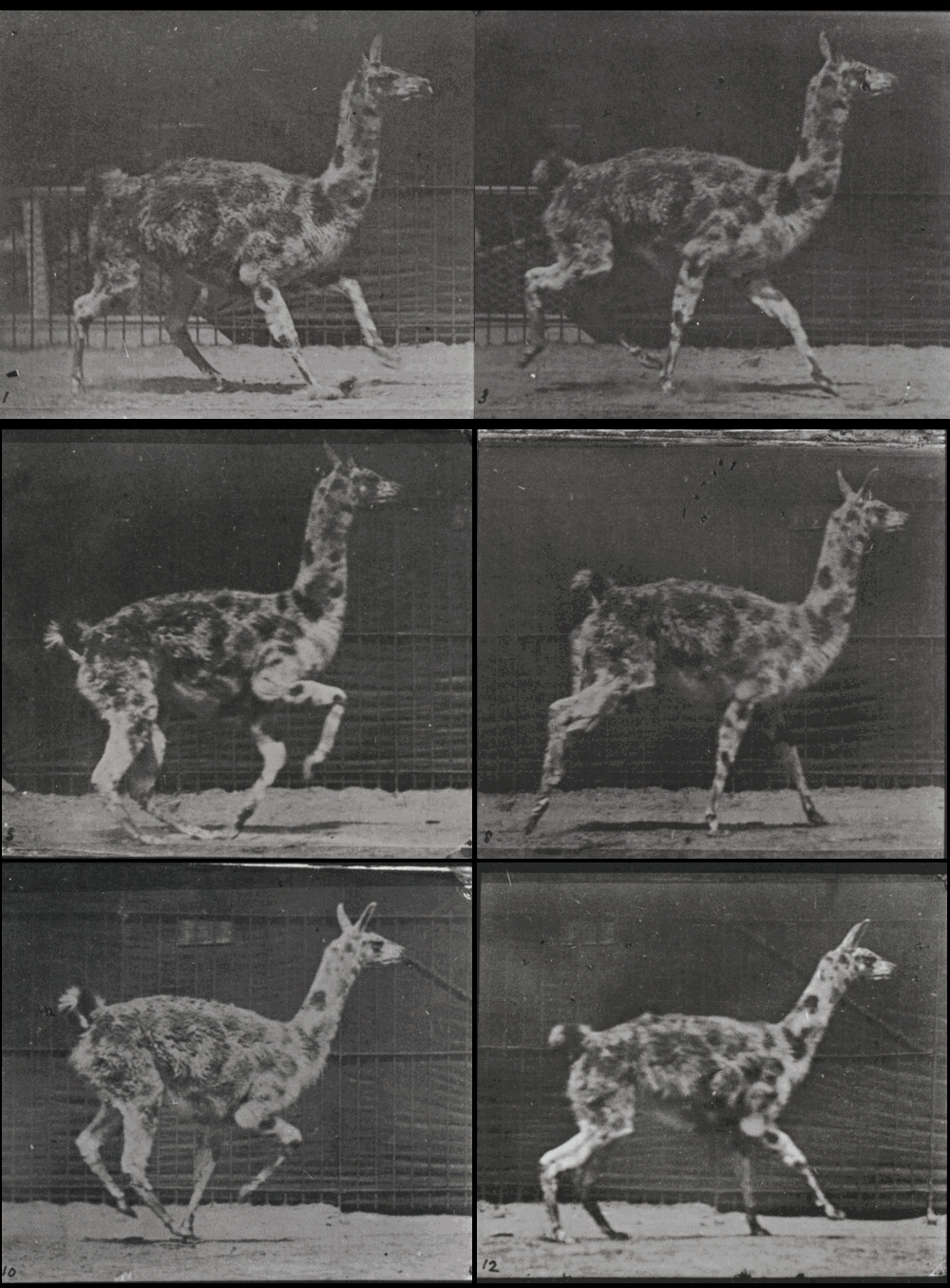
Eadweard Muybridge, a foundational photographer and innovator of moving images, captured The Horse in Motion in 1878. The sequence proved that a galloping horse lifts all four hooves off the ground at once. In July 1887 he published Animal Locomotion, a 781-plate collection commissioned by the University of Pennsylvania, though he had made the photographs in 1884 and 1885. Of these, 562 show humans as the primary subject. Plates 563 to 657, around 100 in all, are horses. The best known is Annie G., a thoroughbred bay mare captured at a gallop in plate 626. The remainder capture other animals: livestock such as mules and goats, and wild animals such as elephants, lions, and birds of prey.
The initial purpose of the project was to demonstrate that interoperable, open collections allow primary sources to be assembled across repositories with clarity and ease. The result, however, also demonstrates that the IIIF Presentation API can do more than display static images — it can render two-dimensional works as fluid, sequential animations, as shown in the Rendering Resources Sequentially on a Timeline recipe, which details the use of compounding behavior and duration properties to create a sequence of images that play one after the other.
A bespoke workbench was developed to support annotating the 20,000+ frames of the 781 plates. Each frame was annotated manually with Annotorious to include the movement as defined by Muybridge and his colleagues, along with a normalized animal vocabulary. Rows of aligned annotations were drawn using an offset value and frame count tool designed specifically for this project. The annotations were then exported and transformed into IIIF Manifests, combined into a single IIIF Collection, and provided as a single resource from which the project was constructed as a static site using Canopy IIIF.
Colophon
Muybridge in Motion is a digital project by Mat Jordan in Academic Innovation at Northwestern University Libraries with the support of leadership, Kelsey Rydland and James Lee. The initial idea came from a conversation with Trip Kirkpatrick of Yale University Libraries, who first suggested that a cookbook recipe he authored might be used to animate frames of a IIIF resource to showcase the movements captured on flat plates. The project could not be completed as easily without the open-source commitment of Rainer Simon and his Annotorious project, which allowed for annotation of the 20,000+ frames of the 781 plates.
The digital project was developed as a customized implementation of Canopy IIIF, a static site generator for IIIF materials. A static workbench was developed on the side to support annotating image frames and updating metadata. All images are provided by their respective institutions: 722 from the National Gallery of Art, 57 from the Smithsonian Institution, and two (2) from Boston Public Library, Digital Commonwealth. Metadata has been extended to include each movement as defined by Muybridge and his colleagues, along with a normalized animal vocabulary. The animations are built using the IIIF Presentation API and rendered using Clover IIIF, developed by Northwestern University Libraries with contributions from other institutions.