Positioning Exoticism: The Picturesque and its Visual Mediations in Thomas Daniell's A Hindoo Place of Worship
Yuetong (Alysa) Xia
A Hindoo Place of Worship is an aquatint by Thomas Daniell, engraved in 1804 by Joseph Stadler, and sold in 1805 in Britain by Edward Orme. During Daniell's seven-year journey in India from 1786 to 1793, the artist created this landscape painting in the style of the picturesque, an aesthetic device that emphasizes naturalistic qualities of landscapes. Focusing on qualities of beauty and harmony, the picturesque not only enabled artists to create romanticized views of India, but they also showed how travel illustrations were mediums to conduct broader scientific inquiry.1
This work conformed to the conventions of landscape painting with its tripartite composition with a "darkened foreground, highlighted middle distance, and background."2 The prominent midground hosts central figures engaging in ritual activities around a vertical pillar, one standing upright, one seated and the other bowing. This Hindu shrine of worship, indicated by the title, is surrounded by nature in the foreground and background. Collectively, nature establishes a S-shaped path for the viewer's gaze to follow, starting from the patches of darker grass in the lower-right to the clouds of the upper right. The use of the picturesque reveals to the modern audience the tensions in the artist's role in the growing British mercantile control of the Indian subcontinent. Daniell presents a British topographical account of the Indian landscape that integrates its exoticism into the familiar British visual language and negotiates visual accuracy with a perspective that legitimized further British control.
The picturesque presents a vision of harmony and beauty with "fundamental desire to stabilize disorienting currency of the alien through familiar cultural paradigms and practices."3 Capturing an unfamiliar Indian landscape and transforming it into a "pure landscape,"4 Daniell reorganizes its components to suit the British audience. He simplified his portrayal of each of the unfamiliar dark-skinned human figures, who wore unique headdresses and clothing that only covered their lower bodies. Grouping them around the central pillar, Daniell further constructed a zoomed-out perspective to capture the wider Indian landscape, displayed in the grass, trees and clouds in this composition. This perspective allowed human figures to appear compositionally less significant than the landscape, thus subsuming the unfamiliarity of the subject matter with the picturesque composition and maintaining the landscape's decorum by subduing such exoticism in the picturesque aesthetic.
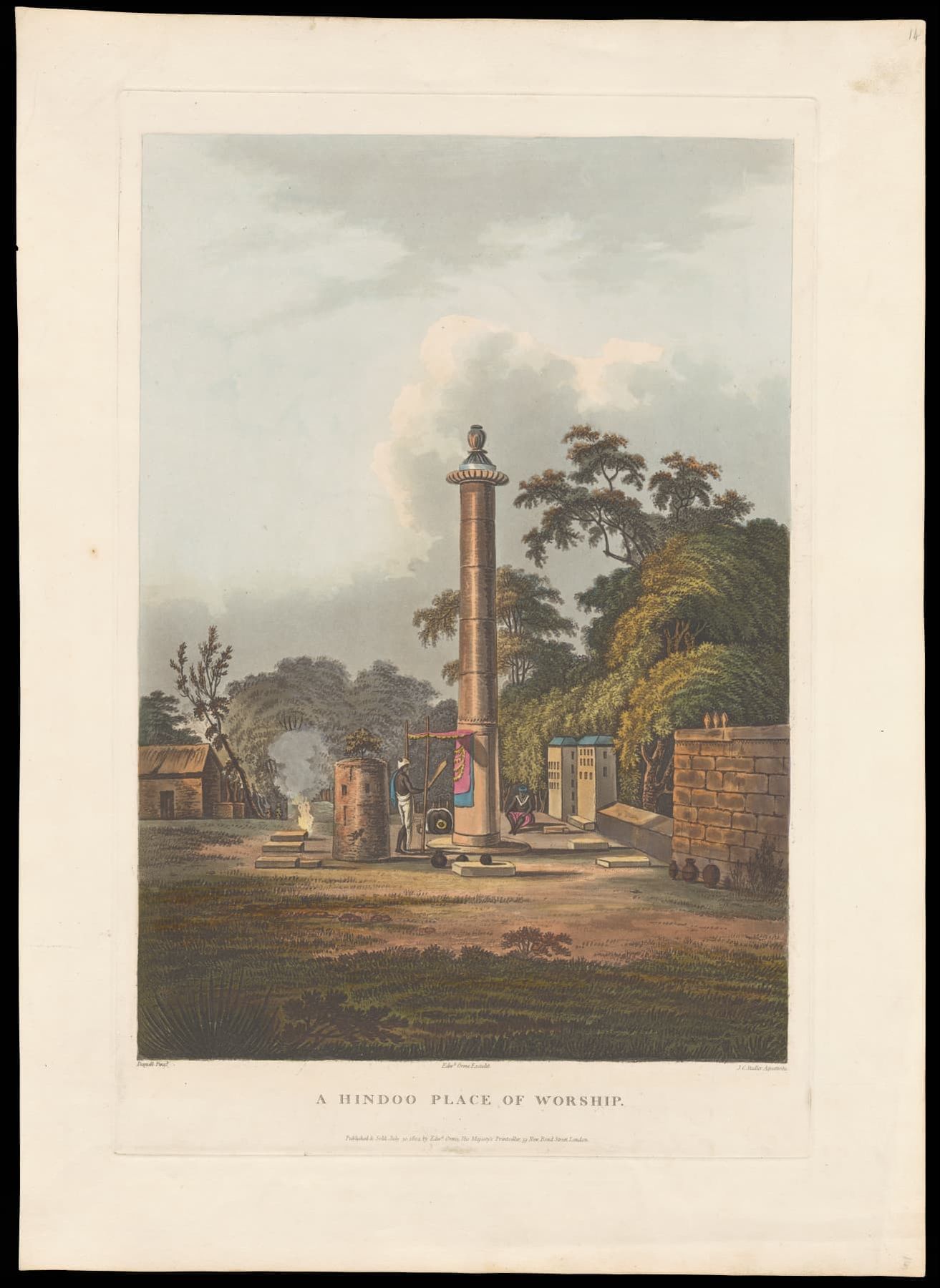
Figure 1. Thomas Daniell (1749-1840), A Hindoo place of worship. Engraving, in A brief history of ancient and modern India printed for Edward Orme, by William Bulmer and Co. (London, 1805). Northwestern University Libraries.
These visual rearrangements of the Indian landscape in the picturesque tradition displayed a negotiation between narrative accuracy and the Company's mercantile desires. Details in the shrubbery and trees indicated the usage of the camera obscura on-site in the design process where Daniell traced outlines of the projected inverted image in the dark box.5 Claiming more accuracy via rendering these botanical differences, such practice emphasized how the eyewitness account "endows the imagery with historical specificity -- it was made 'in this place', 'at that time' -- and yet dissociates the artist/author from any single location or perspective ... a sort of imperial flâneur."6 Daniell's depiction of human figures without making eye contact with each other allows this scene to appear incidental, further crediting to its on-siteness and historical specificity while presenting the artist as an observer of local practices. Therefore, Daniell devotes his efforts in achieving absolute visual accuracy instead of inserting personal interests.
However, while this eyewitness account justifies his narrative accuracy, subsequent process of engraving and publication and its function as souvenirs from Daniell's travels may change the appearance of this print.7 The text of "Published & Sold, July 30, 1804, by Edwd Orme, His Majesty's Printseller, 59 New Bond Street" at the bottom of the image demonstrates this change. When subsequent processes were completed in Britain, this aquatint may be susceptible to changes in its portrayal of the Indian landscape under incentives to legitimize British governance over the subcontinent. As travel illustrations, this aquatint circulated back and was reprinted onto more commodities traded in the British market, subjecting the Indian landscape to commercial consumption. Thus, in doing so, the picturesque introduces the discrepancy between Daniell's original construction and the audience reception of this landscape as entities ready for British consumption.
Thus, Daniell's stylistic rendering of A Hindoo Place of Worship reveals the tension in his depiction of an Indian landscape via reframing the unfamiliar Indian landscape within a British aesthetic and negotiating between its visual accuracy and audience reception. Daniell's choices of proportion between the human figures and the landscape redirect attention from the figures' sheer exoticism to their harmonious integration in nature. The negotiation between the visual accuracy of on-site production and its pictorial reception further complicates Daniell's portrayal of the Indian landscape to the British audience. Ultimately, the picturesque grapples with these complications of the portrayal of the Indian landscape by a British artist during the mercantile control of the British East India Company, revealing the discrepancy between recording and representation.
Works Cited
Fordham, Douglas. Aquatint Worlds: Travel, Print and Empire, 1770-1820. New Haven and London: Paul Mellon Centre for Studies in British Art, distributed by Yale University Press.
Quilley, Geoff. "Travels in India: Landscape and Colonial Patronage." In British Art and the East India Company. Woodbridge: Boydell Press, 2020. https://doi.org/10.1017/9781787445437.003
Ray, Romita Ray. "Introduction." In Under the Banyan Tree. New Haven: Yale University Press, 2013.
Smith, Sean P. (2019). "Aestheticising empire: the colonial picturesque as a modality of travel." Studies in Travel Writing, 23:3, 280-297. DOI: 10.1080/13645145.2019.1710903
Footnotes
-
Geoff Quilley, "Travels in India: Landscape and Colonial Patronage," in British Art and the East India Company (Woodbridge: Boydell Press, 2020), https://doi.org/10.1017/9781787445437.003 ↩
-
Sean P. Smith (2019), "Aestheticising empire: the colonial picturesque as a modality of travel," Studies in Travel Writing, 23:3, 282. ↩
-
Romita Ray, "Introduction," In Under the Banyan Tree, (New Haven: Yale University Press, 2013), 3. ↩
-
Douglas Fordham, Aquatint Worlds: Travel, Print and Empire, 1770-1820 (New Haven and London: Paul Mellon Centre for Studies in British Art; distributed by Yale University Press), 99. ↩
-
Fordham, Aquatint Worlds, 66. ↩
-
Geoff Quilley, "Travels in India: Landscape and Colonial Patronage," in British Art and the East India Company (Woodbridge: Boydell Press, 2020), 97. ↩
-
Ibid. ↩