Imperial Vision and Sacred Space: The Great Triad in the Cave Temple of Elephanta near Bombay
Ashley Kim
The cave temples of Elephanta form one of the most striking surviving monuments of early medieval Indian sculpture. Carved into the volcanic rock of Elephanta Island near Bombay (present-day Mumbai), the complex preserves a monumental Hindu sanctuary. At its center is a colossal three-faced image of the god Shiva (Sadashiva), conceived as an embodiment of cosmic power expressing the fierce, pensive, and gentle aspects of the deity within a unified sculptural presence.1 By the early nineteenth century, however, British explorers encountered monuments like Elephanta less as religious sites than as subjects for antiquarian study. William Westall's depiction of The Great Triad in the Cave Temple of Elephanta near Bombay (fig. 1) demonstrates how British visual culture turned sacred Indian architecture into sites of imperial surveillance and Orientalist spectacle for European audiences.
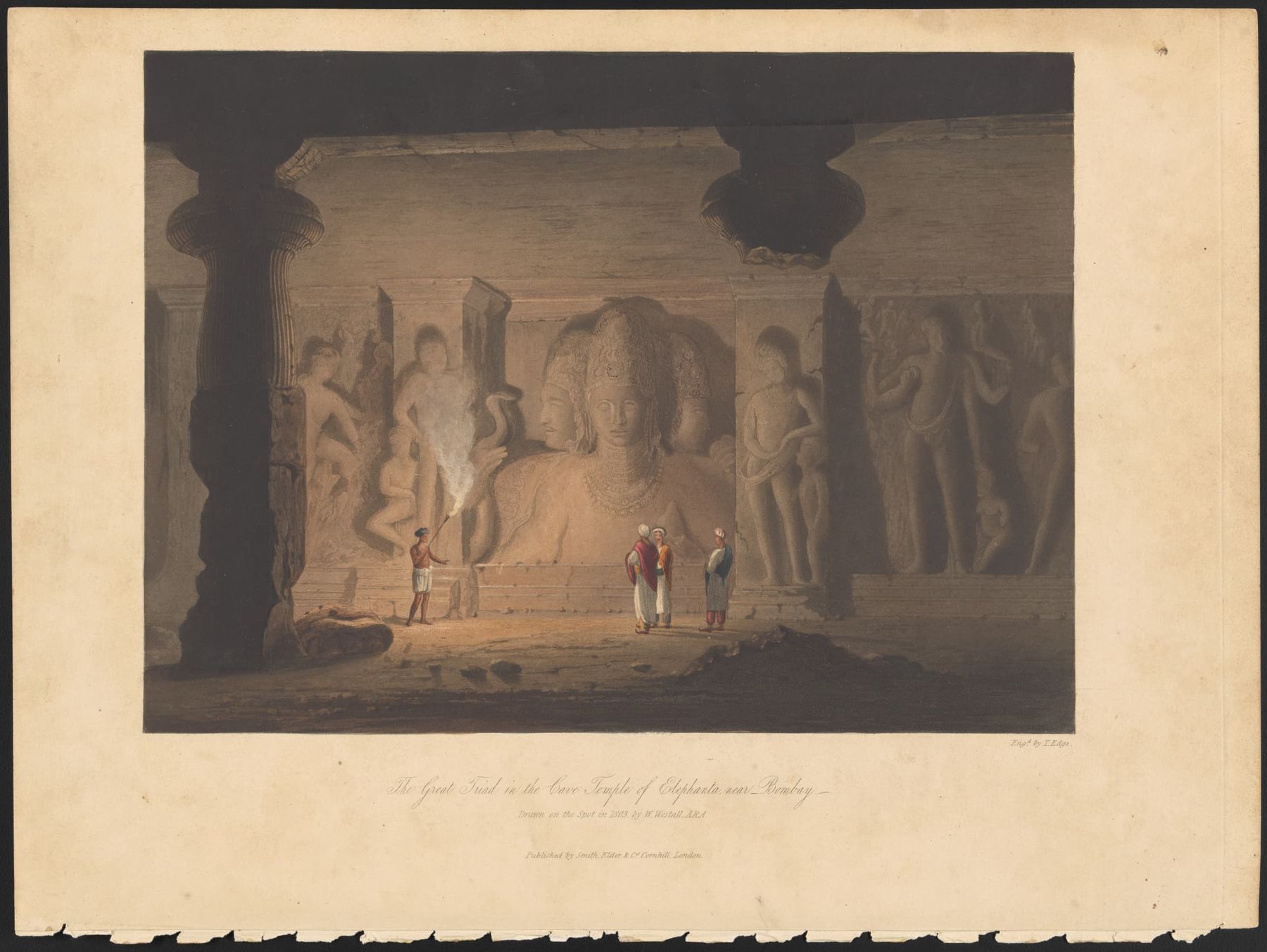
Figure 1. William Westall (1781-1850), The Great Triad in the Cave Temple of Elephanta near Bombay. Aquatint engraved by T. Edge, in Robert Melville Grindlay, Scenery, Costumes and Architecture, Chiefly on the Western Side of India (London: Smith, Elder, and Co., 1826-1830). Donald K. Adams and Lawrence D. Stewart Collection of Prints, Northwestern University Libraries.
Westall (1781-1850) drew The Great Triad on site while traveling with the East India Company in 1803. The image later underwent several stages of production before appearing as an aquatint. T. Edge engraved the plate, which Captain Robert Melville Grindlay (1786-1877)—a British military officer and entrepreneur—issued as part of a larger project documenting Indian landscapes and architecture for metropolitan audiences. Published in London by Smith, Elder, and Co., the print appeared in Grindlay's illustrated volume Scenery, Costumes and Architecture, Chiefly on the Western Side of India (1826-1830).2 In this form, the monumental sculpture of Shiva at Elephanta was translated into a reproducible image for consumption by distant viewers.
Art produced in India by British artists during the East India Company years is often associated with the genre of Company painting—works typically commissioned for private patrons and circulated within elite domestic spaces. Illustrated travel publications operated differently: books like Scenery, Costumes and Architecture disseminated images of Indian landscapes and monuments through printed volumes circulating within imperial networks of trade, travel, and antiquarian curiosity. Within this context, Westall's Great Triad functioned as one of several Elephanta views guiding metropolitan readers through the cave complex. Now preserved as a separate aquatint sheet—removed from the bound folio in which it originally circulated—the print records the shifting material life of these images as they moved from imperial publication to archival collection.
Viewers of The Great Triad encounter Shiva from deep within the dim interior of the Elephanta caves. The deity's triadic form dominates the rock wall, flanked by guardian figures embedded in triple height pillars. These architectural elements frame the sculpture and emphasize its grand scale. In the foreground, four figures occupy the temple floor: three turbaned men in colorful layered shawls and a barefoot torchbearer who directs his flame toward the sculpture, guiding both the men and the viewer's gaze toward Shiva.
The torchlight reveals the broad contours of the Shiva carving but obscures more delicate iconographic elements, including his third eye and attributes such as the crescent moon or serpents. Their partial disappearance in the print reflects both the technical limits of aquatint reproduction and the artist's incomplete grasp of the monument's theological complexity or Hindu culture whatsoever.
The viewing position established in Westall's image becomes especially significant when considered within colonial depictions of Oriental landscapes. British artists frequently framed Indian monuments through picturesque conventions emphasizing ruins, natural scenery and architectural spectacle while minimizing iconographic details and ornamentation within religious sites. Such images positioned viewers within a detached observational framework that transformed monuments into spectacles for distant audiences.3 In this sense, the image operates through a touristic gaze: the European observer remains outside the frame while local figures appear primarily as markers of scale and access. In the Great Triad, the torch-bearing guide and surrounding figures direct the viewer's gaze toward the sculpture, reinforcing the spectator's detached position within the cavern interior.
The logic of staged viewing becomes clearer when the image is considered alongside other Elephanta views published within Grindlay's illustrated folio (figs. 2, 3, 4). Other Elephanta views illustrate the cave's entrance, interior hall, and exterior approach, forming a visual itinerary that culminates in the monumental sculpture represented in the Great Triad. These images guide the viewer progressively through the site, transforming the temple complex into an ordered sequence of viewpoints that simulate the experience of a guided tour through the monument.
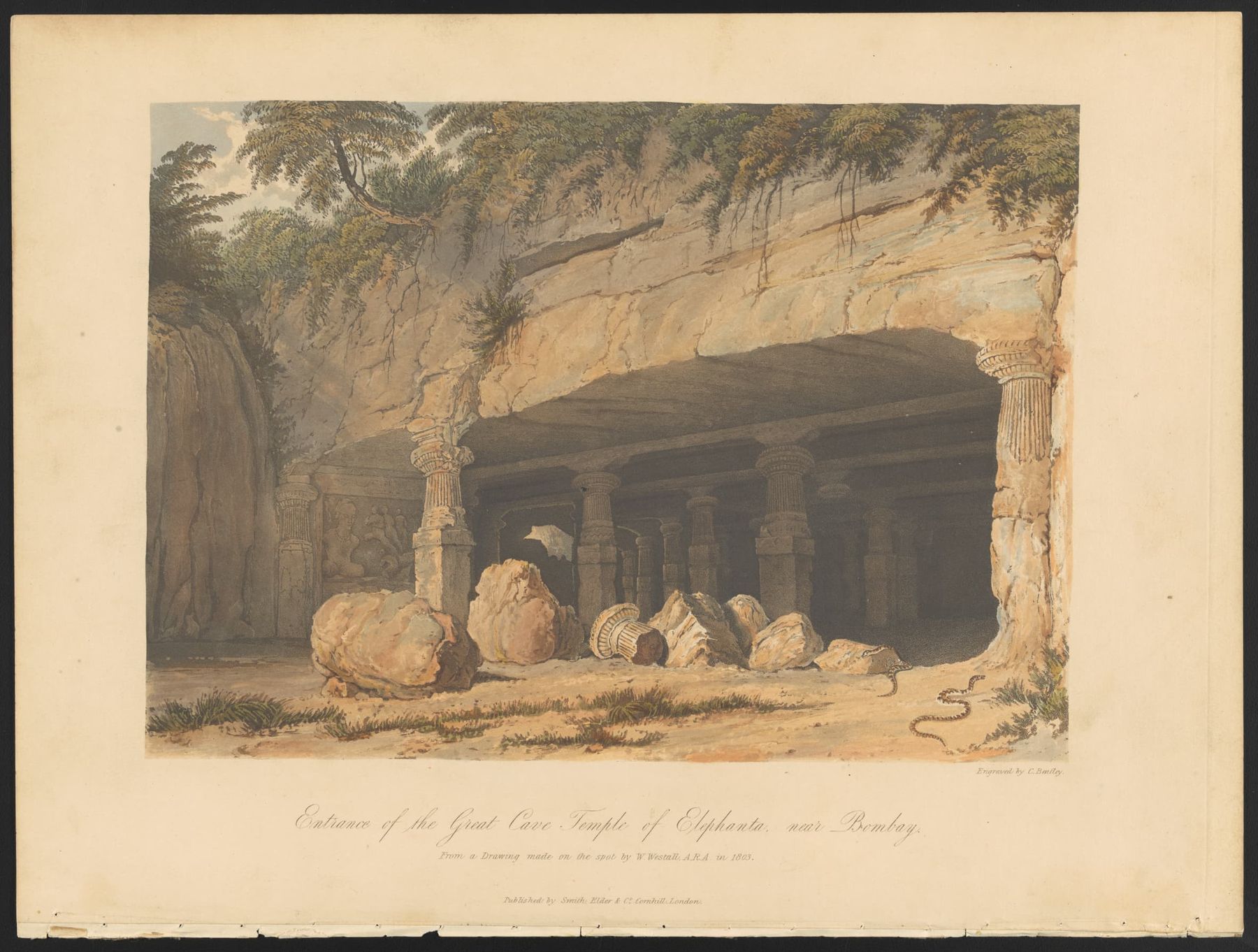
Figure 2. William Westall (1781-1850), View of the Entrance to the Great Cave Temple of Elephanta. Aquatint engraved by T. Edge, in Robert Melville Grindlay, Scenery, Costumes and Architecture, Chiefly on the Western Side of India (London: Smith, Elder, and Co., 1826-1830). Donald K. Adams and Lawrence D. Stewart Collection of Prints, Northwestern University Libraries.
Figure 3. William Westall (1781-1850), Interior of the Great Cave Temple of Elephanta near Bombay. Aquatint engraved by T. Edge, in Robert Melville Grindlay, Scenery, Costumes and Architecture, Chiefly on the Western Side of India (London: Smith, Elder, and Co., 1826-1830). Donald K. Adams and Lawrence D. Stewart Collection of Prints, Northwestern University Libraries.
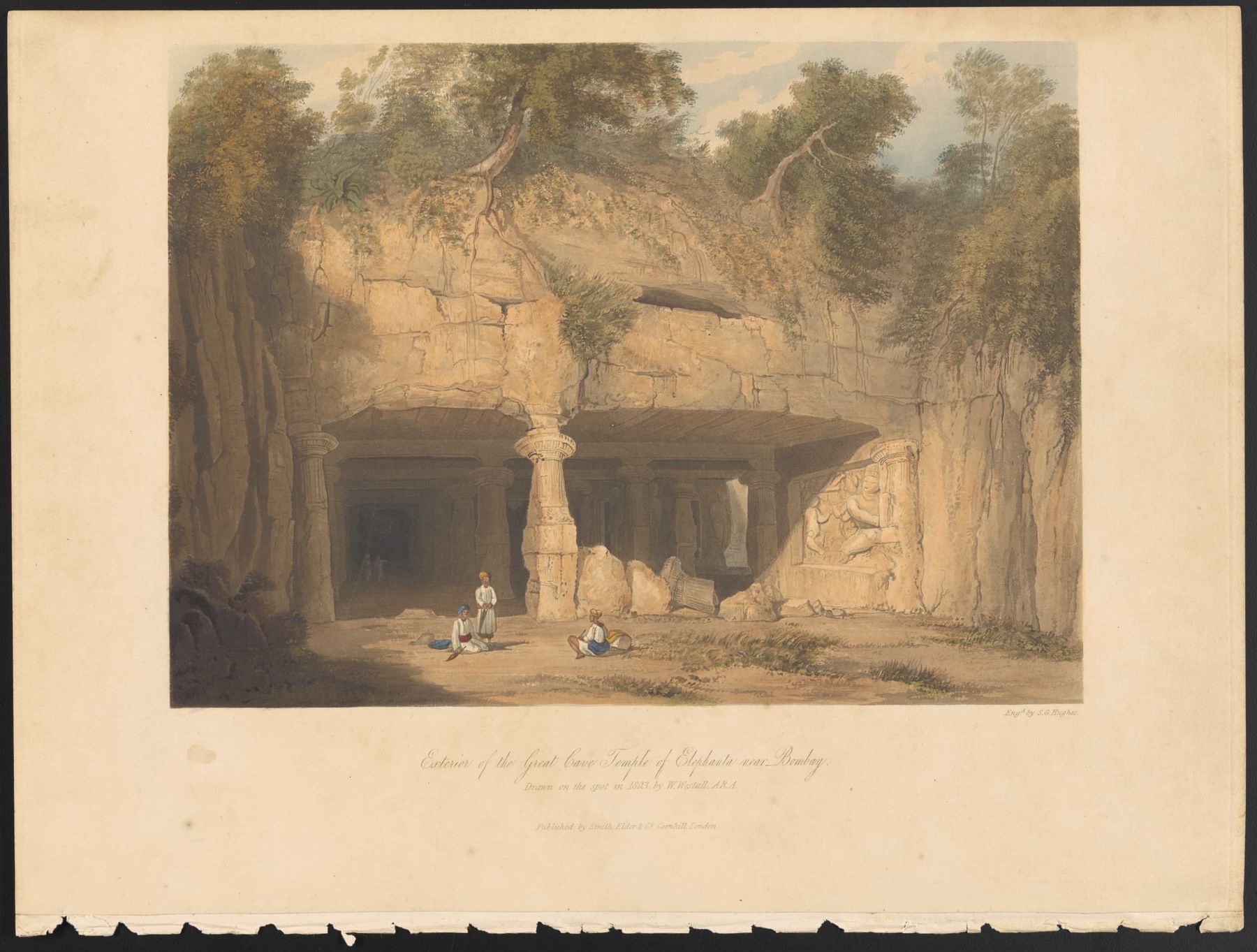
Figure 4. William Westall (1781-1850), Exterior of the Great Cave Temple of Elephanta near Bombay. Aquatint engraved by T. Edge, in Robert Melville Grindlay, Scenery, Costumes and Architecture, Chiefly on the Western Side of India (London: Smith, Elder, and Co., 1826-1830). Donald K. Adams and Lawrence D. Stewart Collection of Prints, Northwestern University Libraries.
Yet the publication's framing also exposes the limits of colonial knowledge. Grindlay's title promises views "chiefly on the western side of India," but the volume assembles images from a far broader geography, including scenes from Ceylon (present-day Sri Lanka). Rather than documenting a clearly defined region, the series constructs a loosely organized panorama of imperial territory. In this process, sites that originally functioned as centers of sacred ritual were reframed as architectural monuments within systems of colonial documentation and visual study.4
A different strategy of visual translation appears in J. Pass's engraving The Cave or Temple of Elephanta, with a Sketch of the Style of Architecture in the Temple of Paradise (fig. 5). Produced for Encyclopaedia Londinensis in 1810, the engraving divides the monument into two distinct visual registers: a perspectival view of the cave interior and a schematic architectural comparison placed above it. The upper diagram isolates structural elements of the monument and aligns them with the "Temple of Paradise," suggesting an attempt to classify Indian architecture within a broader framework of imperialist fantasy.5 Such encyclopedic images functioned not merely as illustrations but as tools of antiquarian description, presenting distant monuments to European readers through a detached observational framework. While Westall's aquatint emphasizes atmospheric encounter—the dim interior, the torchlight, and the scale of the sculpture—Pass's engraving instead approaches the site as an object of analytical study. Yet this classificatory impulse produces its own distortions. By fragmenting the monument into diagrammatic elements, the engraving reduces the sacred space to a comparative architectural type.
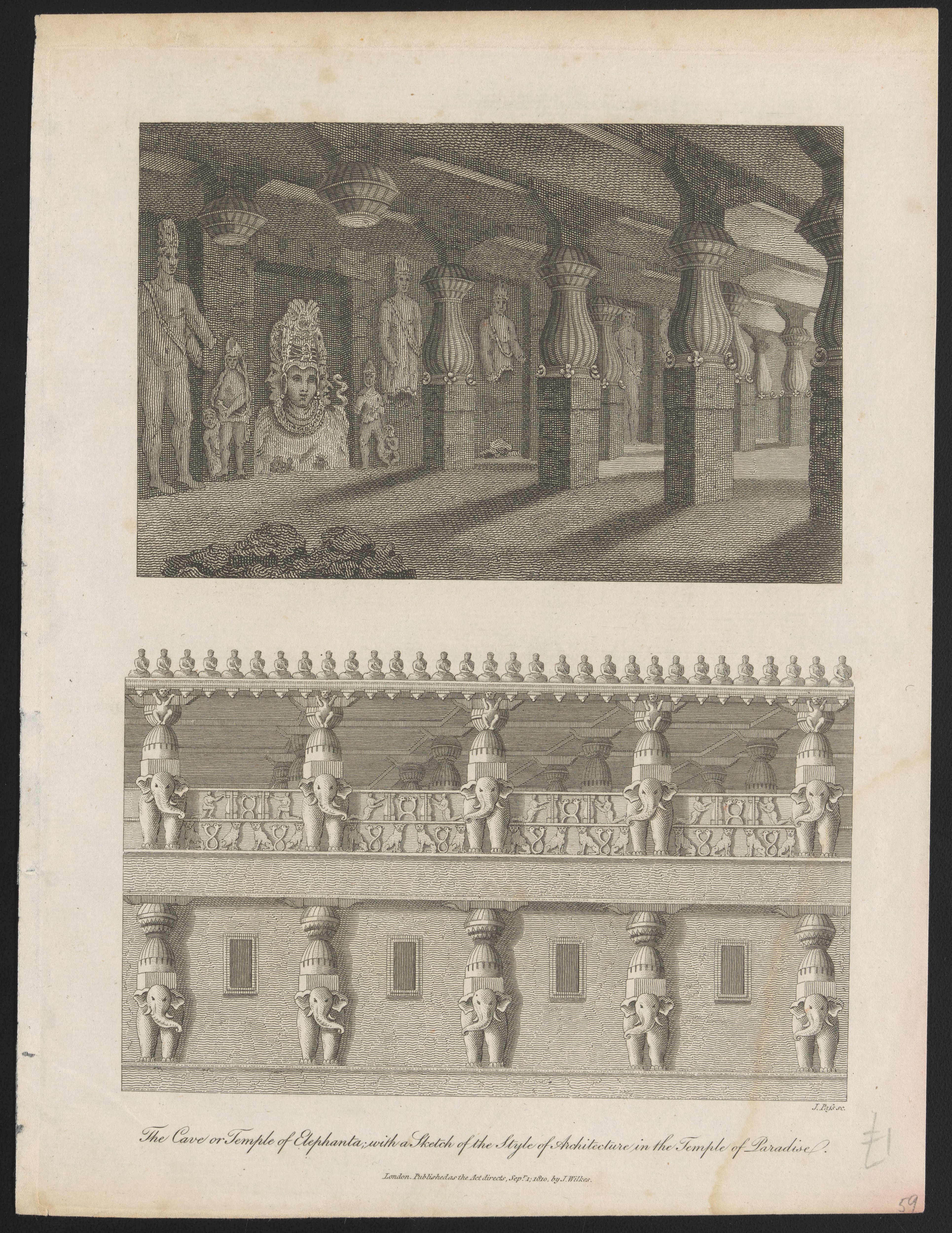
Figure 5. J. Pass, The Cave or Temple of Elephanta, with a Sketch of the Style of Architecture in the Temple of Paradise. Engraving, in Encyclopaedia Londinensis (London, 1810). Northwestern University Libraries.
Seen together, these images demonstrate how early nineteenth-century British visual culture approached the Elephanta caves through different yet equally partial forms of understanding, translating religious architecture into scenery, specimen, and monument. If Pass's engraving reveals the classificatory impulse of encyclopedic knowledge, Westall's image—circulated through Grindlay's illustrated publication—offers a different but equally mediated mode of encounter.
Preserved today within the Donald K. Adams and Lawrence D. Stewart Collection at Northwestern University's McCormick Library of Special Collections, these aquatint sheets—torn from their original bound folios—record the archival afterlives of early nineteenth-century illustrated publications. In The Great Triad in the Cave Temple of Elephanta near Bombay, the monumental image of Shiva—once conceived as an embodiment of cosmic power—appears through a European rendering that recasts its interior for distant viewing. Framed by pillars and torchlight, the composition directs attention toward the triad even as iconographic details central to its Hindu meaning fade from view. Just as the original sculpture operated within networks of ritual practice and pilgrimage, the aquatint entered a different system of circulation, translating Indian monuments into visual knowledge for imperial audiences. Seen alongside related engravings, it reveals how British visual culture transformed sacred architecture into images legible under Orientalist spectacle and imperial observation.
Works Cited
Guha-Thakurta, Tapati. Monuments, Objects, Histories: Institutions of Art in Colonial and Post-Colonial India. New York: Columbia University Press, 2004.
Knapp, Bettina L. "The Dance of Siva: Malraux, Motion and Multiplicity." Twentieth Century Literature 24, no. 3 (1978): 358-71. https://doi.org/10.2307/441277.
Meister, Michael W. "Access and Axes of Indian Temples." Thresholds 32 (2006): 35-40.
Pass, J. The Cave or Temple of Elephanta, with a Sketch of the Style of Architecture in the Temple of Paradise. Engraving. In Encyclopaedia Londinensis. London, 1810. Northwestern University Libraries Digital Collections.
Westall, William. The Great Triad in the Cave Temple of Elephanta near Bombay. Aquatint engraved by T. Edge. In Robert Melville Grindlay, Scenery, Costumes and Architecture, Chiefly on the Western Side of India. London: Smith, Elder, and Co., 1826-1830. Northwestern University Libraries Digital Collections.
Footnotes
-
Knapp, Bettina L. "The Dance of Siva: Malraux, Motion and Multiplicity." Twentieth Century Literature 24, no. 3 (1978): 363. https://doi-org.turing.library.northwestern.edu/10.2307/441277. ↩
-
William Westall, The Great Triad in the Cave Temple of Elephanta near Bombay, aquatint engraved by T. Edge, in Robert Melville Grindlay, Scenery, Costumes and Architecture, Chiefly on the Western Side of India (London: Smith, Elder, and Co., 1826-1830), Donald K. Adams and Lawrence D. Stewart Collection of Prints, Northwestern University Libraries, Digital Collections. ↩
-
Tapati Guha-Thakurta, Monuments, Objects, Histories: Institutions of Art in Colonial and Post-Colonial India (New York: Columbia University Press, 2004), 12. ↩
-
Michael W. Meister, "Access and Axes of Indian Temples," Thresholds 32 (2006): 35. ↩
-
J. Pass, The Cave or Temple of Elephanta, with a Sketch of the Style of Architecture in the Temple of Paradise, engraving, in Encyclopaedia Londinensis (London, 1810), Northwestern University Libraries, Digital Collections. ↩