Shades of Empire: Pigments as Anti-Imperialist Battlegrounds
Louis Chavey
In Seated Woman Sewing, the fabric of what seems to be a casual, folk-style ghagral pleated skirt is spread over a woman's leg as she sews. Similarly, in Seated Man Making Lanterns, traditional Indian lanterns are made by fixing what seems to be lightweight fabric or paper surrounding the man onto thin, yellow wooden or bamboo supports; above are already finished products. Painted on the silicate mineral mica, these pocket-sized miniatures were typically sold in a set at a commercial marketplace as a sort of travel souvenir. With their non-descript backgrounds, these miniatures followed in the artistic tradition of firka (series of paintings). Demand for these sets was largely driven by European markets' desire for ethnographic images of Indian occupations, habits, and daily life. Naturally, these artists catered their style slightly to European audiences through elements like perspective, light, and shade1—seen through the shadow cast to the right of the woman and her ghagral, as well as the shadowing on the man's lanterns. There was not a complete shift towards European style, however, as precise brushwork and organizing isolated figures into visual patterns across the set were retained from Mughal lineage.2 Regardless of whether the Indian yellow used here was industrially or traditionally produced, its use alongside Indigo to highlight craft labor subverts these pigments' histories of industrial exploitation and in sustaining colonial British rule. Distinguishing the ghagral and lamps from their respective backgrounds, these pigments further the other formal qualities connecting the miniatures to Mughal court painting by asserting this Indian artistic identity in spite of colonial British influence.
Commissioned by the British East India Company during the 18th and 19th century (termed Company paint), a new addition to the Northwestern Special Collections shows the extraction of resources—both natural and cultural—that characterized Britain's colonization of India. Although mediums among the works may vary, they all nevertheless convey Britain's romanticized fascination with India at the time. By illuminating the connections between artistic usage and economic production of the pigments Indian yellow and Indigo, respectively, in imperialist Company works, a reassertion of local prowess under colonial rule lies in disrupting the economic systems of pigment production.
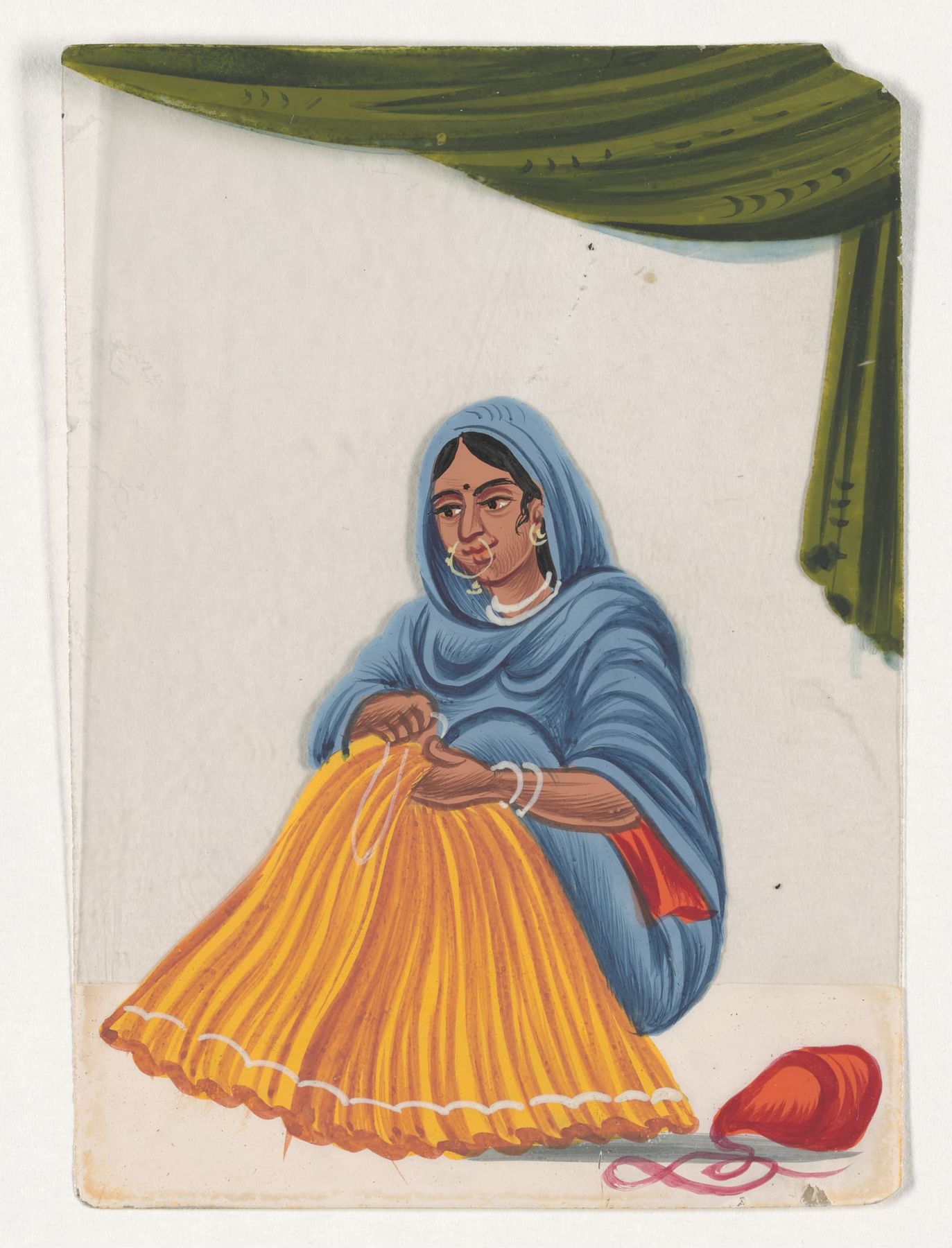
Figure 1. Unknown Indian Artist, Miniatures on Mica, [Seated Woman Sewing] (ca. 1840). Gouache on mica, Charles Deering McCormick Library of Special Collections of Northwestern University Libraries, 751.77095 M665.
The use of Indian yellow, also known as puree, shows that when economic production impinges upon cultural and religious beliefs, the resulting mobilization against its production deconstructs European representational conventions. Originally produced in Bihar and Bengal, puree was made from the urine of cows solely fed mango leaves. Although Indian artists largely rejected the resulting pigment, the cruelty of production was largely shielded from Europe as "Indian yellow was...praised for its fineness in conveying the subtleties of skin colors...especially useful in creating a dark brown flesh tone."3 This dark brown skin tone was used to depict Indians in many Company works, ranging from small background figures in large-scale sceneries to even works similar to Seated Woman Sewing and Seated Man Making Lanterns. Regardless of how much spatial focus was given to an Indian subject these miniatures, seldom were they ever afforded much artistic focus: "The isolation of figures from any landscape or narrative setting, as well as the relative stasis of their poses, freezes them as objects for scientific observation."4 In part, repeated use of Indian yellow in dark brown skin tones helped to standardize the real Indian people into what were essentially data points for European consumers. As the production of puree heightened to match growing European demand, Indigenous Cow Protection Societies threatened to destabilize British rule, as outrage flared into communal conflicts by the late 19th century.5 In response to the civil unrest, "the British palette had changed, and a particular mode of depicting colonized subjects [with Indian yellow] had diminished aesthetic appeal precisely because the process of acquiring the raw materials to produce these depictions had itself become a threat to British rule."6 In this sense, resistance against British suppression of religious principles also becomes a fight against the aesthetic exoticization of 'Indian types' in Company art because both systems—legislated religious suppression and aesthetic tastes reducing Indians into types—can be seen as supporting each other: Justification for this pigment production also highlights how these practices were viewed as sacrilegious behavior towards a culturally revered animal. Indian assertion of respecting Hindu religious traditions is also an assertion of meaningful identification and representation, beyond just being generalized colonial subjects with no agency.
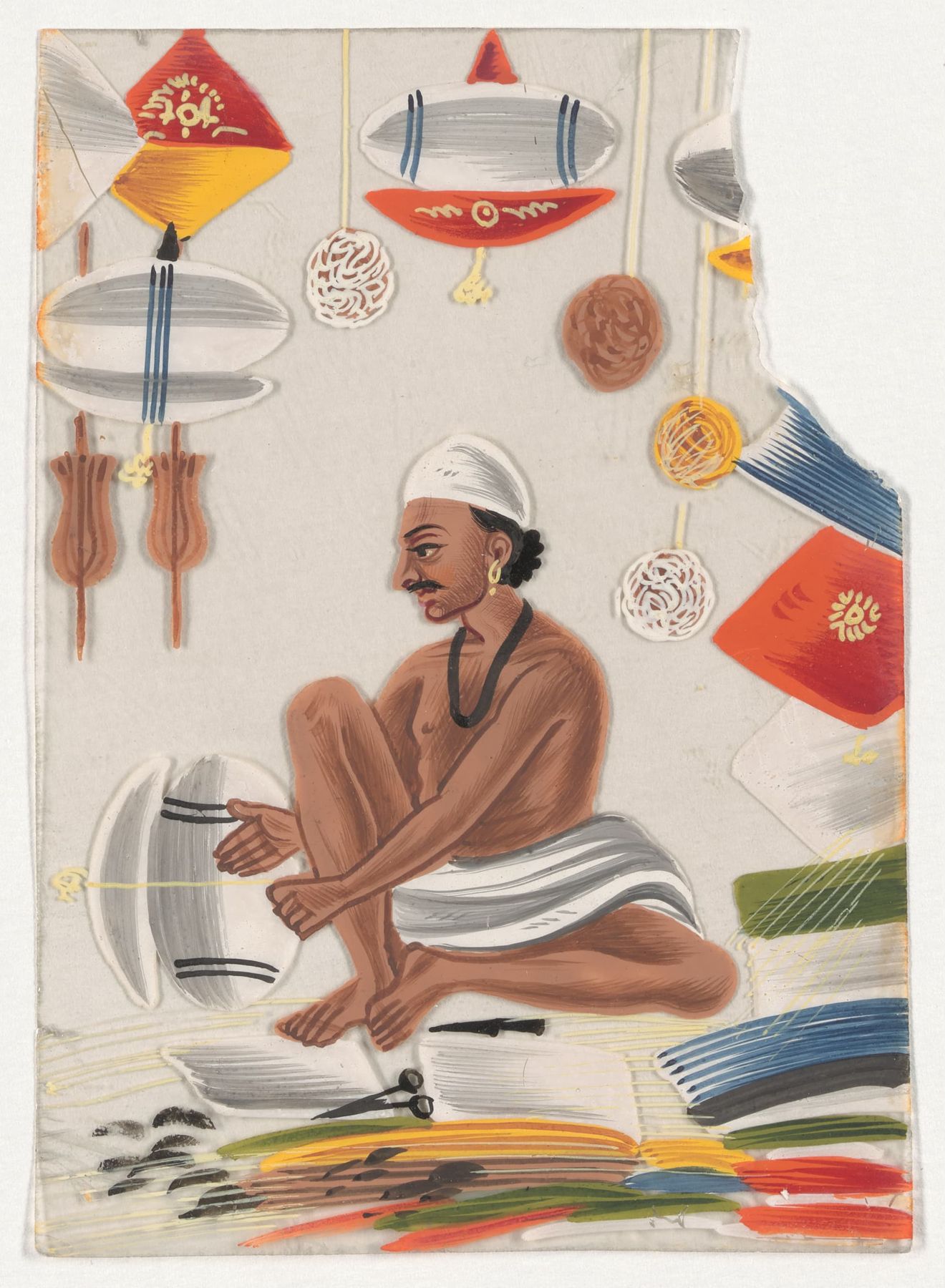
Figure 2. Unknown Indian Artist, Miniatures on Mica, [Seated Man Making Lanterns] (ca. 1840). Gouache on mica, Charles Deering McCormick Library of Special Collections of Northwestern University Libraries, 751.77095 M665
Producing Indigo, another key pigment, also created a gruesome impact on Indian bodies that necessitated going beyond mere disruption of industrial indigo production to artisanal methods recalibrating laborers' relationships with the pigment. Prized as a brilliant blue dye, Indigo was produced from Indigofera tinctoria leaves steeped in alkaline (khari) and sweet (mithā) vats, then fermented or boiled and agitated to oxidize and collect the indigo-blue sediment.7 As British East India Company presence grew to meet European demand, however, production was scaled and mechanized into factories.8 In many landscape works commissioned by the British East India Company, Indigo was often used to paint dark spaces with a "calm and solemn" shade9. Packaged within a palatable pictorial aesthetic, these works used detached, quasi-scientific and militaristic observation to encourage commercial buy-in to the ideal of an uncolonized India.10 These landscapes staged an imperial fantasy of conquest, with indigo shading the distant horizon beneath clouds to deepen the work's mystery. That Indigo was a diffused, looming presence in the shadows within imperialist depictions all too closely mirrors its marks of suffering on the Indian bodies economically subjugated to produce it: "Labouring in indigo vats at night, or hidden in Western factories, barracks, gaols, shipped with bodies to imperial wars, its intense saturation could and did disguise sweat, dirt, blood and tears."11 The reality of this imperial glory that Indigo helped promise was built from a similar shrouding of "sap, sweat, blood from the whip" embedded in the final product.12 As planters moved operations north to Bihar after earlier revolts, the same forced indigo system (tinkathia) persisted until the Gandhi-led Champaran Satyagraha of 1917, a non-violent peasant protest that abolished tinkathia due to planter abuses.13 With Gandhi championing self-sufficient, domestic, and thus strictly anti-industrialist production of textiles, Indigo production followed suit: "Champaran's indigo agitation [was linked] to contemporary handloom practice, displaying naturally dyed textiles and small-vat experiments...thereby reframing indigo as a medium of craft resilience rather than plantation extraction."14 Indigo goes further than Indian yellow in illustrating that pigment's usage in art is intertwined with dismantling the same economic systems producing it: A symbol of economic resistance must also reframe how the goods are used to offer an alternative vision of the future—of Indigo as a slowly produced, sacred pigment as opposed to just another economic good supporting an imperialist vision.
Ultimately, reasserting core aspects of Indian culture—Hindu protections of cows with Indian yellow and incorporating Indigo production into self-sustaining, craftsmanlike traditions predating industrialization—reclaims economic systems of pigment production for domestic, not colonial, benefit through means that deconstruct the very imperialist ideals propagated through art that were supporting these systems. Although pigments allow artists to imagine new realities and redefine existing ones, their production is still rooted in this reality and the economic systems supporting it. If new art hopes to better realize new conceptions of reality, the systems producing the means for this imagination—the pigments, canvases, and other art materials—should align with the hopes and values fueling artists' imaginations.
Works Cited
Archer, Mildred. Patna Painting. London: David Marlowe Ltd. for The Royal India Society, 1948.
Bailkin, Jordanna. "Indian Yellow." Journal of Material Culture 10, no. 2 (July 2005): 197-214. https://doi.org/10.1177/1359183505053075.
Balser, Trevel Morley. "Ethnographic Types in Colonial India: A Study of a Nineteenth-Century Album of Paintings on Mica." PhD thesis, The Ohio State University, 1998.
Eaton, Natasha. "Nomadism of Colour: Painting, Technology and Waste in the Chromo-Zones of Colonial India c.1765-c.1860." Journal of Material Culture 17, no. 1 (March 2012): 61-81. https://doi.org/10.1177/1359183511432988.
Eaton, Natasha. "'Swadeshi' Color: Artistic Production and Indian Nationalism, ca. 1905-ca. 1947." The Art Bulletin 95, no. 4 (2013): 623-41. http://www.jstor.org/stable/43188857.
"India." Mood Indigo, March 24, 2016. https://indigo.site.seattleartmuseum.org/portfolio/india/.
"Indigo Exhibition." NIFT. Accessed March 15, 2026. https://www.nift.ac.in/indigo-exhibition.
Nangia, Tamanna. "Satyagraha | Mahatma Gandhi, Nonviolent Resistance, Civil Disobedience, Champaran, Kheda, & India | Britannica." Britannica. Accessed March 16, 2026. https://www.britannica.com/topic/satyagraha-philosophy.
Shaffer, Holly. "The Company We Keep: Art, Commerce, and Empire." Essay, 9-24. New Haven, CT: Yale Center for British Art, 2026.
Shaffer, Holly, and Sharma, Yuthika. "To Fill 'A Gap in Indian History.'" Archives of Asian Art 74, no. 1 (April 1, 2024): 79-128. https://doi.org/10.1215/00666637-11169093.
"Indian Dyes and Dyeing Industry during 18-19th Century." Unnatisilks, June 16, 2022. https://www.unnatisilks.com/blogs/fiber-talk/indian-dyes-and-dyeing-industry-during-18-19th-century?srsltid=AfmBOoppcDeG75LgvOrLzw4MF3zAYw5aDoYQgUreoeo1wwTglikZM1gW.
Quilley, Geoff. "Chapter 3 Travels in India: Landscape and Colonial Patronage." British Art and the East India Company, December 31, 2020, 93-156. https://doi.org/10.1515/9781787445437-005.
Footnotes
-
Holly Shaffer and Yuthika Sharma, "To Fill A Gap in Indian History'," Archives of Asian Art 74, no. 1, 103 ↩
-
Shaffer and Sharma, "To Fill A Gap in Indian History," 105-106, 111 ↩
-
Jordanna Bailkin, "Indian Yellow." Journal of Material Culture 10, no. 2 (July 2005), 202 ↩
-
Trevel M. Balser, "Ethnographic Types in Colonial India: A Study of a Nineteenth-Century Album of Paintings on Mica." PhD thesis, The Ohio State University, 1998, 71. ↩
-
Bailkin, "Indian Yellow", 206. ↩
-
Bailkin, "Indian Yellow", 202. ↩
-
"Indian Dyes and Dyeing Industry during 18-19th Century." Unnatisilks, June 16, 2022. ↩
-
"India." Mood Indigo, March 24, 2016. ↩
-
Natasha Eaton. "Nomadism of Colour: Painting, Technology and Waste in the Chromo-Zones of Colonial India c.1765-c.1860." Journal of Material Culture 17, no. 1 (March 2012), 68. ↩
-
Geoff Quilley, "Travels in India: Landscape and Colonial Patronage", 125. ↩
-
Eaton, "Nomadism of Colour", 68. ↩
-
Eaton, "Nomadism of Colour", 68. ↩
-
Tamanna Nangia, "Satyagraha | Mahatma Gandhi, Nonviolent Resistance, Civil Disobedience, Champaran, Kheda, & India". ↩
-
"Indigo Exhibition." NIFT, 2017. ↩