Imagining the Mughal Court: European Reconstruction of the Weighing Ceremony in Ceremony of Weighing the Great Mogul
Vicky Wang
The importation of Indian goods, along with both written and visual accounts by travelers, introduced readers to distant landscapes and customs, stimulating their curiosity about these foreign cultures. One such artwork is the engraving Ceremony of Weighing the Great Mogul, published in John Hamilton Moore's A New and Complete Collection of Voyages and Travels (1785), a compilation of travel accounts that covers voyages to regions across multiple continents (see fig. 1).1 Within the context of Moore's book, the depiction of the weighing ceremony in the print can easily be mistaken for a documentary representation of the ritual. However, visual comparisons between the print and other artworks depicting the same ceremony reveal that it distorts the historical event. By transforming a formal court ritual into an exotic spectacle, the engraving reflects European fascination with the "Orient" and reinforces stereotypes of the Mughal Empire as despotic and antiquated.
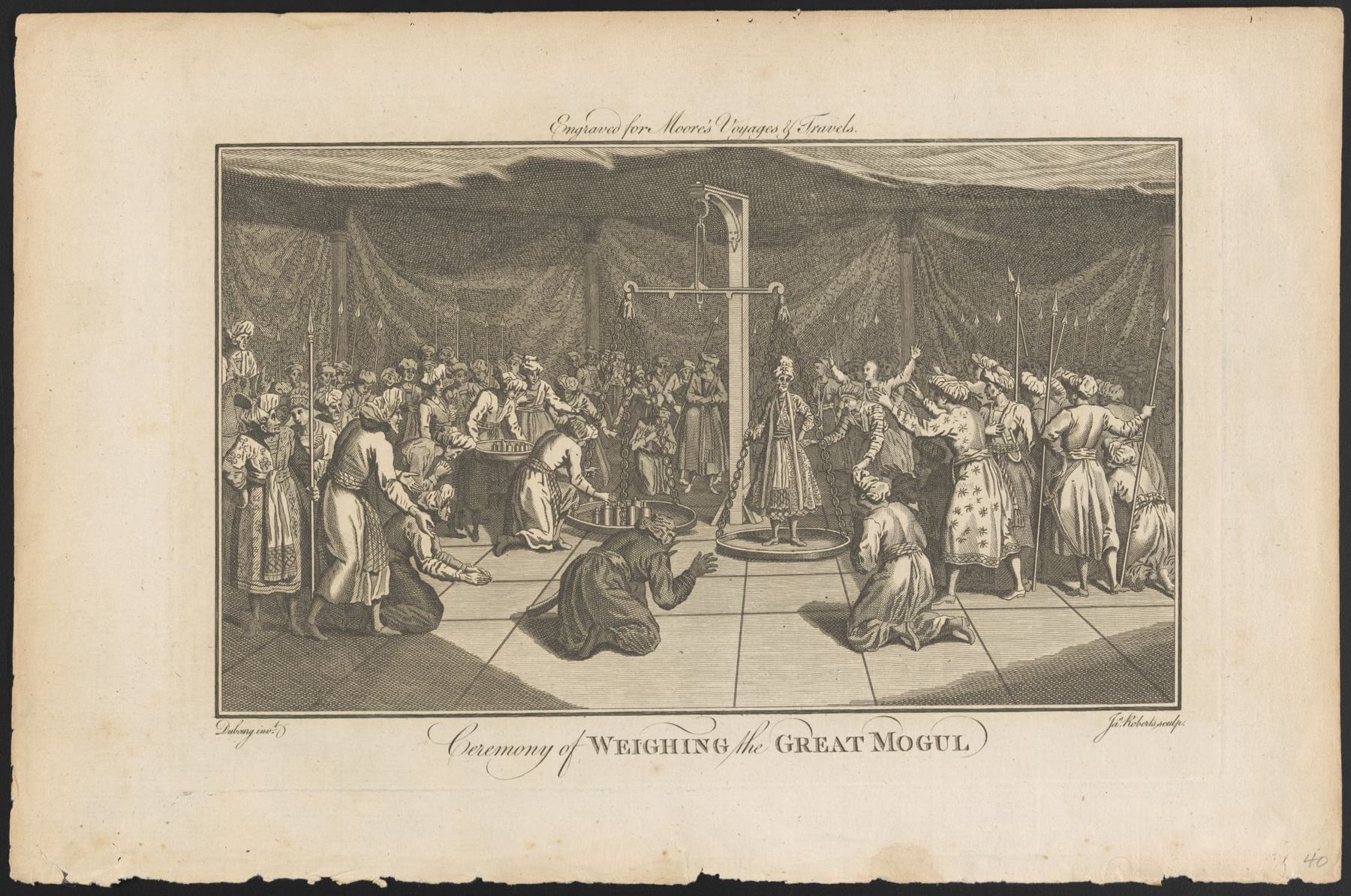
Figure 1. Designer, Louis Fabricius Dubourg (1693-1775) and engraver, James Roberts (1725-1799), Ceremony of Weighing the Great Mogul, in A New and Complete Collection of Voyages and Travels (London: Printed for the proprietors, 1785). Engraving. Courtesy of Charles Deering McCormick Library of Special Collections, Northwestern University, L2 Prints R6452c.
Ceremony of Weighing the Great Mogul depicts the weighing ceremony, a significant ritual of the Mughal court. Traditionally performed on the emperor's solar and lunar birthdays, the ceremony involved weighing the emperor against valuable substances, such as gold, spices, and food, with the equivalent weight in goods then distributed to the public as charity.2 Some accounts also record the ceremony being performed outside of birthdays as a means of averting the evil influence of adverse astrological events.3 Seventeenth-century records of the ceremony emphasized the emperor's wealth and generosity---charitable acts were regularly performed in Mughal courts, and Indian depictions of the ceremony place it within an opulent courtly setting, surrounded by courtiers and officials.4
In contrast to these historical descriptions, Ceremony of Weighing the Great Mogul presents an impressionistic and largely inaccurate illustration of the event. At the center of the scene, the Mughal emperor, termed as the "Great Mogul," stands upright on one pan of a monumental scale, while attendants place metal weights on the opposite pan. A large crowd gathers around the scale---a few figures kneel before the emperor in supplication, while guards and courtiers scatter about, some conversing, some celebrating, and others merely witnessing the scene.
In depictions of the ceremony made by Mughal court painters, such as the Indian painting Emperor Jahangir weighing his son Khurram in gold, as well as the early eighteenth-century European diorama of the Mughal emperor Aurangzeb's birthday, The Throne of Grand Mogul Aurengzeb, the court is portrayed with ceremonial order (see fig. 2). In the former, courtiers stand in orderly rows observing the ritual, while trays of jewels, gold, and other precious goods are arranged neatly before the scale. In the latter, the figures are positioned according to their rank, with the emperor seated on his throne at the center of the scene, atop a staircase with a row of guards on each end, while visiting princes kneel before him at the bottom. Both the Indian painting and the European diorama demonstrate control and order in their compositions rather than dramatic action. Neither of the works presents the Mughal emperor as so accessible, nor the court as so chaotic, as seen in Ceremony of Weighing the Great Mogul. The engraving, rather than conveying the ritual's charitable and ceremonial nature, presents a theatrical scene that aligns with the narrative of the Mughal emperor forcefully demonstrating power. Notably, the emperor's standing posture in the engraving is particularly anomalous: in both comparative works, the central figure is shown seated (in the diorama, though the emperor is not on the scale, he is seated on his throne). These deviations suggest that the depiction in Ceremony of Weighing the Great Mogul was likely not drawn from firsthand observation, but is instead an imaginative reconstruction designed to evoke awe and exoticism through a fanciful rendering of the ritual.
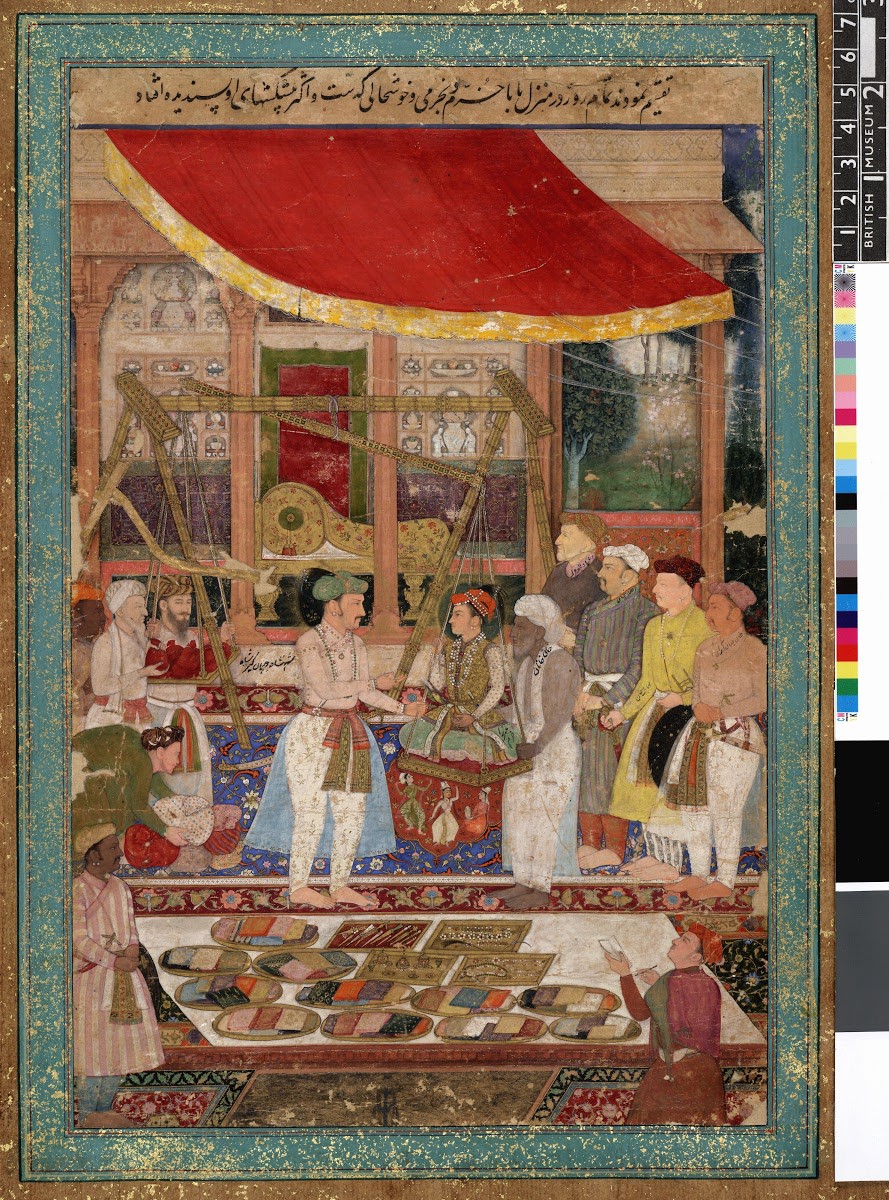
Figure 2. Emperor Jahangir weighing his son Khurram in gold (1615). Ink, opaque watercolour and gold on paper, © The Trustees of the British Museum, Shared under a Creative Commons Attribution-NonCommercial-ShareAlike 4.0 International (CC BY-NC-SA 4.0) licence.
The setting of the engraving further confirms that it is a product of imagination rather than observation. In Jahangir weighing his son Khurram, the setting is richly decorated with carpets featuring intricate patterns, gold and jewel inlays, and Chinese porcelain.5 Even in the European diorama, The Throne of Grand Mogul Aurengzeb (see fig. 3), the setting is lavishly decorated with gold, silver, and thousands of jewels and pearls.6 By contrast, Ceremony of Weighing the Great Mogul depicts the ceremony as taking place in a temporary tent-like space formed by draped curtains. Ornaments are minimal, consisting of a bare tiled floor and plain fabric backdrops. The weighing scales are unadorned, and the emperor is weighed against metal weights rather than valuable goods. This contrast becomes even more apparent when the engraving is compared with the written account that accompanies it, which describes that "the palace is adorned with flambeaux, and so are the avenues leading to it," a spectacle not reflected in the print.7 This sparse setting focuses the viewer's attention on the dramatic action happening, rather than on the courtly context of the ritual, transforming the ceremony into an exotic spectacle that appears unfamiliar to European audiences.
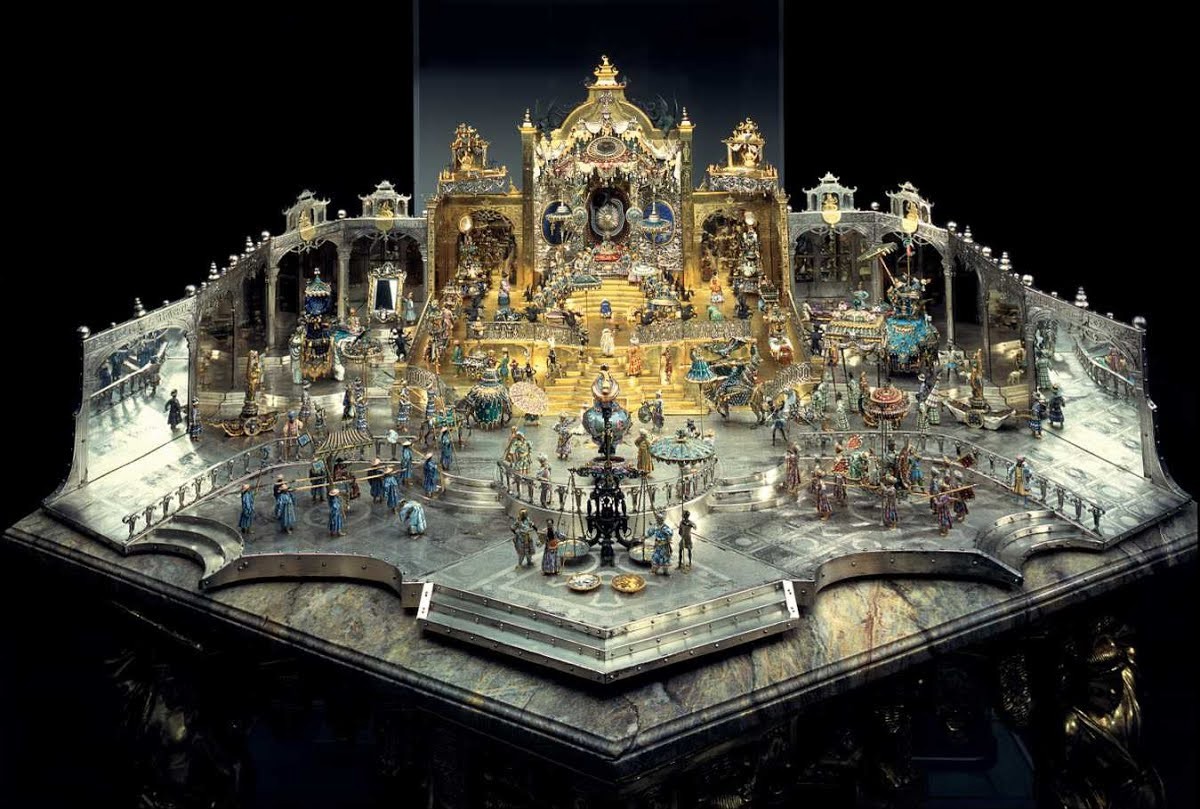
Figure 3. Johann Melchior Dinglinger (German, 1664-1731), Der Thron des Großmoguls Aureng-Zeb (The Throne of Grand Mogul Aurengzeb) (1701-1708). Wooden core, gold, silver, partially gilded, enamel, gemstones, pearls, lacquer painting, © Grünes Gewölbe (Green Vault), VIII 204.
The imaginative reconstruction of the weighing ceremony in Ceremony of Weighing the Great Mogul was not an isolated depiction---it participated in a broader shift in European attitudes toward India. Over the course of the eighteenth century, European attitudes toward the Mughal empire gradually shifted from fascination to increasing criticism of its lavishness and perceived stagnation. Seventeenth-century accounts of India often described the Mughal court as an impressive display of wealth and power, emphasizing its splendor and grandeur. By the late eighteenth and early nineteenth centuries, however, European writers began to interpret the Mughal court more critically: the weighing ceremony was portrayed as an excessive ceremony through which the Mughal emperor sought to "obtain, or even to force," gifts from his guests while offering only trivial rewards in return.8 Such critiques reduced the complex political and charitable purpose of the ritual to mere "showmanship" and "a sham," and extended to the broader conclusion that the splendor of the Mughal court was insubstantial.9 As these narratives circulated widely in Europe, they contributed to a growing stereotype of the Mughal Empire as "weak, lavish, and despotic."10 Artistic depictions such as Ceremony of Weighing the Great Mogul and compilatory texts like A New and Complete Collection of Voyages and Travels both reflect and reinforce this shifting perception, implicitly characterizing the ceremony as ancient, unpleasing, and uncivilized.11
In conclusion, the engraving Ceremony of Weighing the Great Mogul reveals more about European perceptions of India than about Mughal court customs. The image's theatrical composition, simplified setting, and inaccurate details shaped how contemporary readers understood---or misunderstood---the historical ceremony. When compared with Mughal court paintings and earlier European representations of the same ritual, the engraving illustrates how visual culture participated in constructing a European image of the "Orient." As Antje Flüchter notes, these later misperceptions of India, which became increasingly homogeneous in the eighteenth century, were projected back onto earlier periods and obscured the achievements of early modern India.12 Ultimately, artworks like Ceremony of Weighing the Great Mogul do not represent foreign cultures, but transform it into an exotic spectacle that reinforces a distorted, European vision of India.
Works Cited
Flüchter, Antje. "Weighing the Mughal: German Perception of Governmental Structures and the Staging of Power in the Early Modern Indian Mughal Empire." In Structures on the Move: Technologies of Governance in Transcultural Encounter, edited by Antje Flüchter and Susan Richter. Springer, 2012.
Moore, John Hamilton. A New and Complete Collection of Voyages and Travels. London: Printed for the proprietors, 1785.
Schmiedchen, Annette. "The Ceremony of Tulāpuruṣa: The Purāṇic Concept and the Epigraphical Evidence." In Script and Image: Papers on Art and Epigraphy, edited by Adalbert J. Gail, Gerd J. R. Mevissen, and Richard Salomon. Motilal Banarsidass, 2006.
The Heritage Lab. "Mughal Emperor Aurangzeb's Birthday -- in Germany!" Last modified September 14, 2023. https://www.theheritagelab.in/aurangzeb-birthday-diorama/(https://www.theheritagelab.in/aurangzeb-birthday-diorama/)
Welch, Stuart Cary. Imperial Mughal Painting. George Braziller, 1978.
Footnotes
-
John Hamilton Moore, A New and Complete Collection of Voyages and Travels (London: Printed for the proprietors, 1785), title page. ↩
-
Antje Flüchter, "Weighing the Mughal: German Perception of Governmental Structures and the Staging of Power in the Early Modern Indian Mughal Empire," in Structures on the Move: Technologies of Governance in Transcultural Encounter, ed. Antje Flüchter and Susan Richter (Springer, 2012), 147. ↩
-
Annette Schmiedchen, "The Ceremony of Tulāpuruṣa: The Purāṇic Concept and the Epigraphical Evidence," in Script and Image: Papers on Art and Epigraphy, ed. Adalbert J. Gail, Gerd J. R. Mevissen, and Richard Salomon (Motilal Banarsidass, 2006), 165. ↩
-
Antje Flüchter, "Weighing the Mughal," 150. ↩
-
Stuart Cary Welch, Imperial Mughal Painting (George Braziller, 1978), 75; also see Curator's comments for Jahangir weighing prince Khurram against gold and silver, c. 1615-1625, Ink, opaque watercolour and gold on paper, 44.30 x 29.50 cm, The British Museum, 1948,1009,0.69. ↩
-
"Mughal Emperor Aurangzeb's Birthday -- in Germany!" The Heritage Lab, last modified September 14, 2023, ↩
-
John Hamilton Moore, A New and Complete Collection of Voyages and Travels, 677. ↩
-
Antje Flüchter, "Weighing the Mughal," 159. ↩
-
Antje Flüchter, "Weighing the Mughal," 159. ↩
-
Antje Flüchter, "Weighing the Mughal," 162. ↩
-
John Hamilton Moore, A New and Complete Collection, 677. ↩
-
Antje Flüchter, "Weighing the Mughal," 162. ↩