Consuming Exotic Leisure: The Snake Charmer through the Frame of the Picturesque
Muyang Chen
In 1812, British writer James Forbes published the first edition of his travelogue Oriental Memoirs: A Narrative of Seventeen Years Residence in India, offering an account of his nearly two decades in India as a British East India Company official.1 His son-in-law, Marc René de Montalembert, a French émigré who had served in the British Army, was credited as the draftsman of several printed illustrations. By focusing on one of those prints that purported to be based on drawings made on site, Dancing Snake and Musicians (1812; fig. 1) is emblematic of the depiction of exoticized leisure that makes palpable the British consumption of Indian customs. This fabrication is constructed through a complex interplay between visual genres that grapple with the translation of the unfamiliar by adjusting familiar aesthetic parameters.2
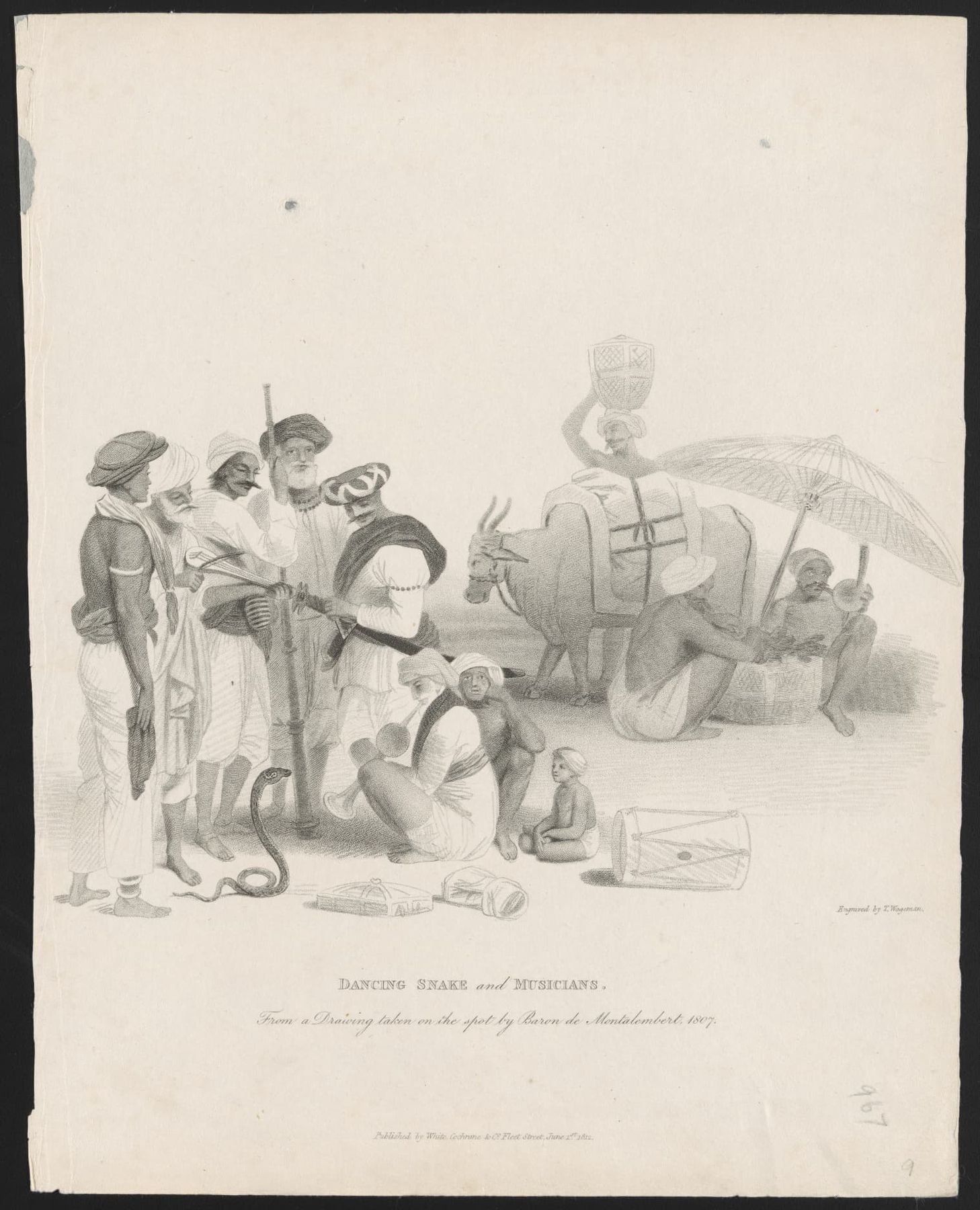
Figure 1. Thomas Charles Wageman (1786-1863), Dancing snake and musicians. Engraving, in Oriental Memoirs by James Forbes, White Cochrane & Co. (London, 1813). Northwestern University Libraries.
The print depicts an exoticized scene in an Indian bazaar. In the left half of the print, a crowd gathers around a snake charmer sitting on the ground and playing his bīn, a traditional Indian wind instrument. Driven by the tune, a serpent (nāga) next to the snake charmer rises from the ground, forming an elegantly curved form. Short engraved lines and dots render the fine scales of the nāga, as well as the spectacle-shaped pattern on its hood that indicates its lethal poisonousness, juxtaposed with its tamed gesture. Another musician is playing an Amtr̥i, a string instrument that fell out of use in the late eighteenth century, to accompany the performance.3 While the scene is set against a blank background, the liveliness of the bazaar is underscored by the figures behind the crowd. In contrast to the sharp delineation of figures in the foreground, these figures are rendered in less detail and with softer, granular lines. The reduced tonal variation and contrast make the background figures appear blurry, suggesting a greater distance from the artist. A vegetable seller and a man wearing turban are sitting underneath a parasol. The seller casually holds a water pipe, while the other figure sits sideways, turning his head toward the viewer. Their sight lines indicate that they recognize the artist's gaze while simultaneously creating a sense of interaction for the viewer.
The snake charmer is a primary subject in the exoticized depiction of the sensorial "Orient" and was central to European interest.4 The snake charmer in the print functions as a quintessential signpost like the banyan tree and the elephant, crystallizing the complexity of colonial life into a "pleasing and graspable vision" for the viewer to enjoy.5 The lethal nāga, a visual symbol of unruly wilderness for the European eye, is presented as tamed by the snake charmer's musical power, emphasizing its role as a docile performer in sensory spectacle and leisure.6 Furthermore, the snake charmer, with the mythical ability to control the serpent, is often compared to the serpent itself for both possessing the power to manipulate animals, thus foregrounding the civilized Europeans in contrast with the primitive "Orient".7 The subduing of exoticized unruliness to provide visual pleasure creates a doubling between the subject matter of the print and the viewing experience for the audience: as the crowd enjoys the performance of the nāga, the viewer is positioned as an audience to be pleased by the spectacle of exotic leisure.
The depiction of the snake charmer as a specimen reflects the burgeoning visual accounts of ethnographic subjects. Often compiled as albums that attempt to organize Indian society into a simplified visual hierarchy for consumption, these accounts sit at the intersection of artistic production and ethnographic inquiry.8 An example can be found in an opaque watercolor of the snake charmer and his wife (fig. 2), published around the 1830s as part of an album of ninety-two drawings categorizing Indian castes and occupations.9 In the painting, the snake charmer is dressed in a lavish red and golden sash and flamboyant feathers tucked in his turban. Both he and his wife are rendered with elaborate golden ornaments. The depiction reflects an aesthetics of precision that aims to form the typical through detailed observation.10 The same aesthetics are evident in the print, where each figure is characterized by a different social type: the soldier with a long sword hanging at his waist, the guard holding a long staff, or the vendor walking alongside his ox. However, the print departs from the depiction of the snake charmer as the flamboyant entertainer, subduing such typological characteristics through his plain clothing while retaining the central elements that mark his occupation. The monochromatic palette of the print and the minimalist depiction, in fact, enhance the documentary quality of a sketch when compared to the elaborate watercolor. Further, while the watercolor drawing removes the figures from any specific context to fixate on the unfamiliarity of the individuals, the print, in comparison, creates an interactive scene by compiling "specimens" of individuals from different tiers of society in a bazaar, creating a romanticized vision of the everyday.11
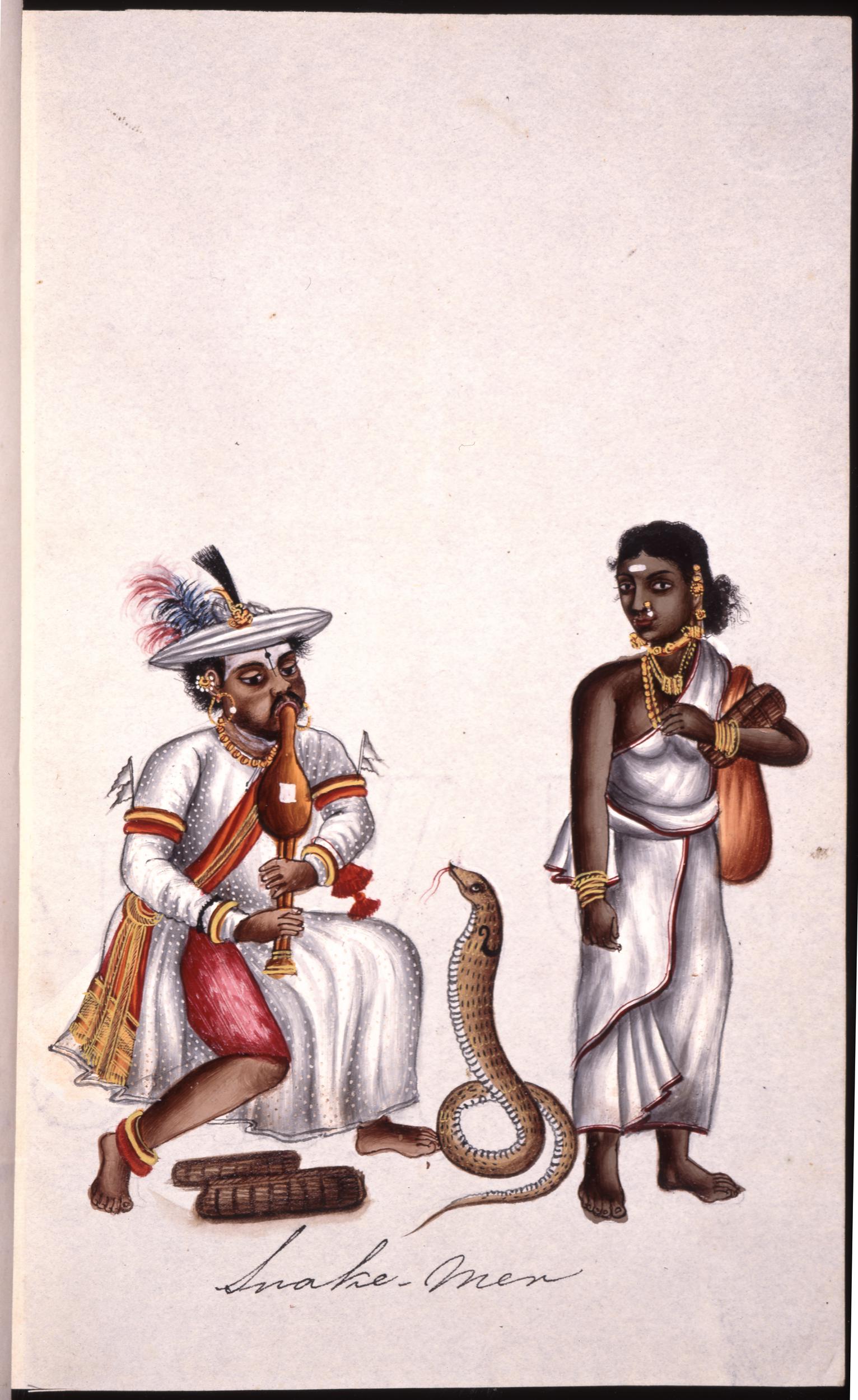
Figure 2. Snake-men (India, c. 1830-1835). Opaque watercolor on paper, © The Trustees of the British Museum. Shared under a Creative Commons Attribution-NonCommercial-ShareAlike 4.0 International (CC BY-NC-SA 4.0) licence.
The sense of authenticity is further underscored by the inscription beneath the image: "From a drawing taken on the spot by Baron de Montalembert in 1807." The draftsperson referred to is Marc René de Montalembert, who served as the aide-de-camp to General Sir John Cradock, the Commander-in-Chief of the Madras Army.12 Montalembert's engagement in military maneuvers is key to his access and mobility. This limited access, mostly available to military and company officers, enabled these artists to claim of authority over the subjects they depicted. The use of soft-ground etching, a technique that was popular from the eighteenth century to the 1820s, further contributes to the construction of eyewitness account.13 By adding a layer of tallow, the ground is kept tacky, preventing it from being lifted as a whole piece and creating fragmented lines with a granular texture that yields the effect of a pencil drawing.14 In this print, the grainy lines are largely used for shading, especially in creating roughly sketched impressions of figures in the back, with varying degrees of detail that underline the sense of immediacy. Besides subject matter, the printmaking technique is also a key contributor to the viewing experience by creating subtle yet rich variations in tone and texture. The print combines etching and engraving, as well as a sophisticated combination of hatching, cross-hatching, and stippling, to enrich the image despite its lack of color.
Dancing Snake and Musicians demonstrates a strategic reinvention of the depiction of ethnographic subjects through the frame of the picturesque, through which India is visualized for the British audience to understand. The print is purported to be an authentic eyewitness account through its construction of an everyday scene, the monochrome palette, and the use of soft-ground etching to yield the effect of pencil-sketched lines. However, it involves the complex work of cultural reconfiguration and translation. As art historian Romita Ray puts it, "the picturesque was driven by the desire to make nature 'do' something, not just 'be.'"15 By anchoring the snake charmer as a palpable signifier of exotic leisure, the print renders a bazaar scene of the everyday where encounters with different occupations occur. Along with the subtle yet complex variation in tone and texture, the print provides an exoticized view that satisfies curiosity yet renders manageable for comfortable consumption, fulfilling the imagination of colonial life.
Works Cited
Eaton, Natasha. "Virtual Witnessing? Balthazar Solvyns and the Navigation of Precision, C.1790--1840." Journal of Historical Geography 43 (January 2014): 49--59. https://doi.org/10.1016/j.jhg.2013.10.001.
Forbes, James. Oriental Memoirs. London: White, Cochrane, and Company Horace's Head, 1834.
Gascoigne, Bamber. How to Identify Prints: A Complete Guide to Manual and Mechanical Processes from Woodcut to Ink Jet. 1986. Reprint, London: Thames & Hudson, 1991.
Gindhart, Maria P. "Ethnographic Exoticism: Charles-Arthur Bourgeois's Snake Charmer." Material Culture Review 79 (March 2016): 7--23. https://journals.lib.unb.ca/index.php/MCR/article/view/24326.
Hardgrave, Robert L. A Portrait of the Hindus: Balthazar Solvyns & the European Image of India 1760-1824. Oxford University Press, 2004.
Ray, Romita. Under the Banyan Tree: Relocating the Picturesque in British India. New Haven: Paul Mellon Centre for Studies in British Art by Yale University Press, 2013.
Yale Center for British Art. "Oriental Memoirs," 2026. https://collections.britishart.yale.edu/catalog/alma:99101644883408651.
Footnotes
-
Despite the book's title referencing seventeen years, Forbes himself states in Oriental Memoirs that he served in the British East India Company for eighteen years. The biographical sketch of the author in the same volume offers further clarification. Born in May 1749, Forbes was appointed to Bombay before the age of sixteen and returned to England in 1784. His actual time in India was therefore closer to eighteen or nineteen years. ↩
-
Romita Ray, Under the Banyan Tree: Relocating the Picturesque in British India (New Haven: Paul Mellon Centre for Studies in British Art by Yale University Press, 2013), 4. ↩
-
Robert L Hardgrave, A Portrait of the Hindus: Balthazar Solvyns & the European Image of India 1760-1824 (Oxford University Press, 2004), 347. ↩
-
Maria P Gindhart, "Ethnographic Exoticism: Charles-Arthur Bourgeois's Snake Charmer," Material Culture Review 79 (March 2016): 8. ↩
-
Ray, Under the Banyan Tree, 17. ↩
-
Ray, Under the Banyan Tree, 112. ↩
-
Gindhart, "Ethnographic Exoticism," 9. ↩
-
Natasha Eaton, "Virtual Witnessing? Balthazar Solvyns and the Navigation of Precision, C.1790--1840," Journal of Historical Geography 43 (January 2014): 51; Gindhart, "Ethnographic Exoticism," 9. ↩
-
This album is currently held in the collection of the British Museum, London, acquired from Reverend Robert Liddell (1808--1888) in 1884. It was produced in Tamil Nadu, southern India. ↩
-
Eaton, "Virtual Witnessing," 53. ↩
-
Eaton, "Virtual Witnessing," 51. ↩
-
James Forbes, Oriental Memoirs (London: White, Cochrane, and Company Horace's Head, 1834), 353. Both Marc René de Montalembert (1777--1831) and his father, Jean Charles de Montalembert (1757--1810), were referred to as Baron de Montalembert. The drawing, however, is dated 1807, which aligns more closely with Marc René de Montalembert, who was then serving as a military officer in India. In 1809 he married James Forbes's daughter, Elizabeth Rosea Forbes. A letter written by Forbes in 1817 further supports this identification, referring to Marc René de Montalembert as "my son-in-law the Baron de Montalembert." ↩
-
Bamber Gascoigne, How to Identify Prints : A Complete Guide to Manual and Mechanical Processes from Woodcut to Ink Jet (1986; repr., London: Thames & Hudson, 1991), 45. The identification of the use of soft-ground etching in the print follows the catalogue entry for Oriental Memoirs at the Yale Center for British Art, which records "Soft-ground etchings by Thomas Charles Wageman," who is also signed as the engraver on the print. ↩
-
Gascoigne, How to Identify Prints, 45. ↩
-
Ray, Under the Banyan Tree, 113. ↩